On this page
- Key takeaways
- What are the most common L-glutamine side effects?
- Is L-glutamine safe to take?
- Can L-glutamine cause diarrhea, constipation or headaches?
- How much L-glutamine does a full label day add up to?
- Are you double counting glutamine with a BCAA powder?
- How should you take L-Glutamine Powder, according to the label?
- Is L-glutamine good for you if you already eat enough protein?
- Who should get a provider's okay before trying L-glutamine?
- FAQ: L-glutamine safety
- Sources
The short answer: The L-glutamine side effects the NIH Office of Dietary Supplements lists are nausea, bloating, burping, pain, gas and vomiting, and it says they're more likely at higher doses. Betterly's L-Glutamine Powder has 3.15 g per 1-scoop (3.3 g) serving, taken 1 to 3 times daily, so a full label day comes to 9.45 g by our math. Its label tells anyone pregnant, nursing, under 18 or living with a medical condition to check with a physician.
Key takeaways
- The NIH Office of Dietary Supplements (ODS) lists nausea, bloating, burping, pain, gas and vomiting as possible glutamine side effects, and says higher doses make them more likely.
- Three scoops of Betterly's L-Glutamine Powder, the label's daily ceiling, come to 9.45 g of L-glutamine, while adults get about 3 to 6 g a day from food, per ODS.
- The 2:1:1 BCAA & L-Glutamine Powder (Fruit Punch) adds 1,000 mg of L-glutamine per 1/2-scoop (6.5 g) serving, so count it if you use both powders.
- Neither tub's label wants you past its stated dose, and both ask you to see a physician before starting if you're pregnant, nursing, under 18 or managing a medical condition.
Glutamine sits on the Supplement Facts panel of two powders we sell, so read this knowing we have skin in the game. To offset that, every product amount below comes from the printed label, any totals are our own math and marked as such, and the safety facts link to the government pages they come from. Our guide to L-glutamine and gut health explains what the amino acid does in the body. This one sticks to tolerance, the gram math and who should ask a professional first.
What are the most common L-glutamine side effects?
The most common L-glutamine side effects are digestive: the NIH Office of Dietary Supplements lists nausea, bloating, burping, pain, gas and vomiting.
That list comes from the glutamine entry in the ODS consumer fact sheet on dietary supplements for immune function. The same entry adds that these effects "are more likely to occur with higher doses of glutamine."
Keep the list in proportion, though:
- Five of its six items are plainly digestive. The sixth, "pain," comes with no location on the page.
- The entry gives no frequency for any of them, so there's no percentage to quote.
Is L-glutamine safe to take?
The NIH Office of Dietary Supplements says glutamine is "considered safe," but that describes the ingredient in general. It isn't a promise about any product, dose or person.
Two ODS pages fill in the picture. The consumer fact sheet on supplements for exercise and athletic performance says studies haven't reported side effects from up to 45 g of glutamine a day, taken for several weeks by adults. The immune function sheet says no interactions between glutamine and medications have been reported.
Read that first line closely. "Several weeks" says nothing about years of daily use, and 45 g is what adults took in studies. It's nearly five times a full label day of our powder, and our label still reads "Do not exceed recommended dose."
Can L-glutamine cause diarrhea, constipation or headaches?
The ODS glutamine lists we read don't include diarrhea, constipation or headaches. So we can't confirm L-glutamine causes them, and we can't rule them out either.
All three come up often in searches. None of the government pages we checked lists them as glutamine side effects. What we can say is that any new powder changes what reaches your gut, and gas and bloating are on the ODS list.
Before you blame the glutamine, ask what else changed that week. A new protein shake, more fiber, a BCAA drink or a harder training block can all show up in your digestion. If glutamine was the only change, drop back to 1 scoop a day or stop it and see whether things settle. If a symptom is severe, or doesn't ease after you stop, call your healthcare provider.
How much L-glutamine does a full label day add up to?
A full label day of Betterly's L-Glutamine Powder is 3 scoops, or 9.45 g of L-glutamine. We multiplied that ourselves, since the tub prints only the per-scoop amount.
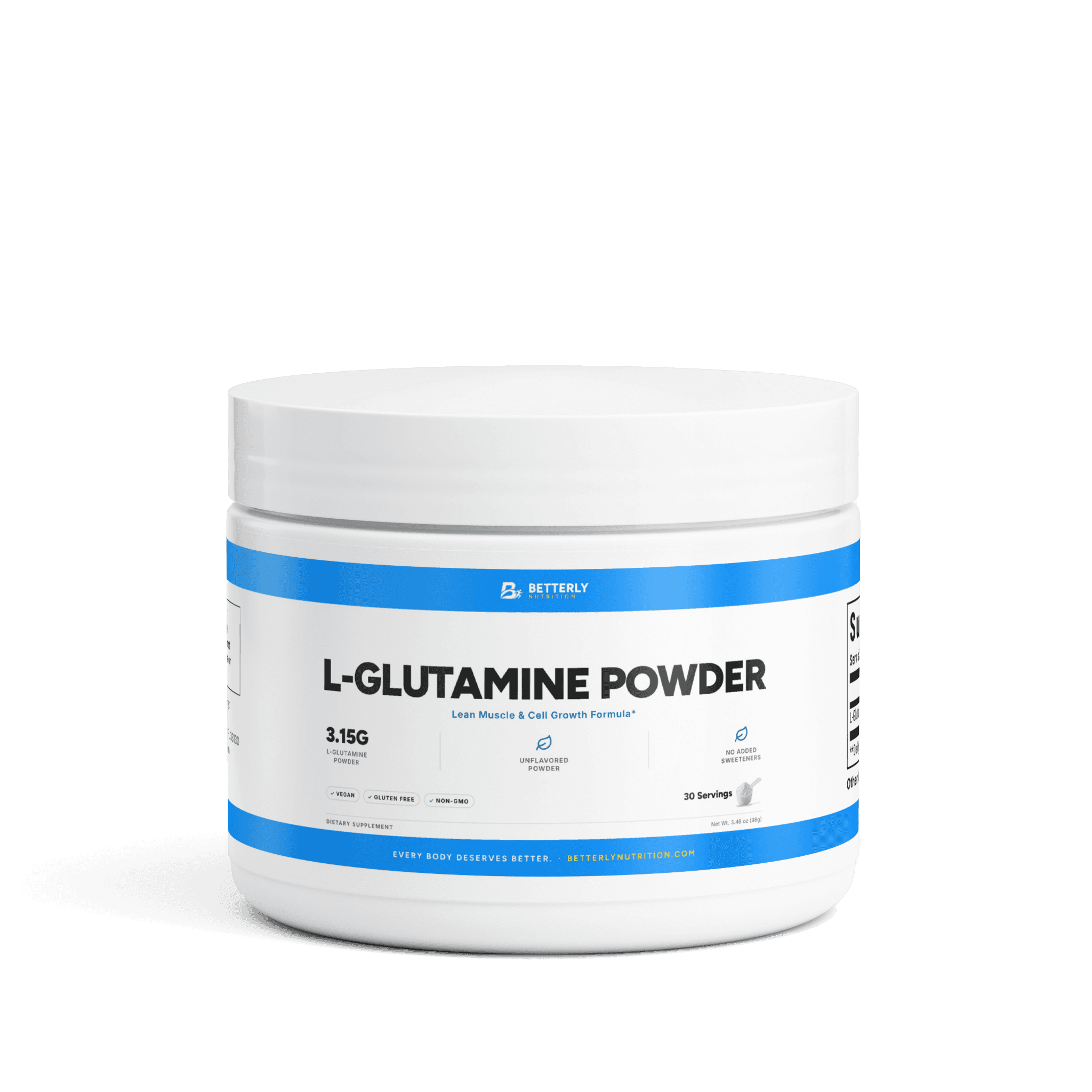
The Supplement Facts panel has one active row: L-Glutamine Powder, 3.15 g per 1 Scoop (3.3 g) serving. Silicon dioxide is the only other ingredient listed. The suggested use reads "1 serving taken 1 to 3 times daily with beverage of choice or as directed by a healthcare professional." Three servings at 3.15 g gives 9.45 g.
There's no %DV to lean on. The panel prints two asterisks and the footnote "Daily Value not established." So the ODS food figure is the handiest yardstick: the exercise fact sheet says adults get about 3 to 6 g of glutamine a day from foods such as meat, poultry, fish, eggs, dairy and legumes.
| Your day | L-glutamine from supplements | Compared with 3-6 g from food |
|---|---|---|
| 1 scoop of L-Glutamine Powder | 3.15 g | Inside the food range |
| 2 scoops | 6.3 g | Just past the top of it |
| 3 scoops (label maximum) | 9.45 g | About 1.5 to 3 times it |
| 3 scoops plus 1 BCAA serving | 10.45 g | More than either label gives alone |
One scoop is about the size of a light day of glutamine from food. A full label day adds more than a heavy food day's worth on top of your meals. ODS doesn't say where a "higher dose" starts. Still, if gas or bloating shows up, the number of scoops is the easiest thing for you to change.
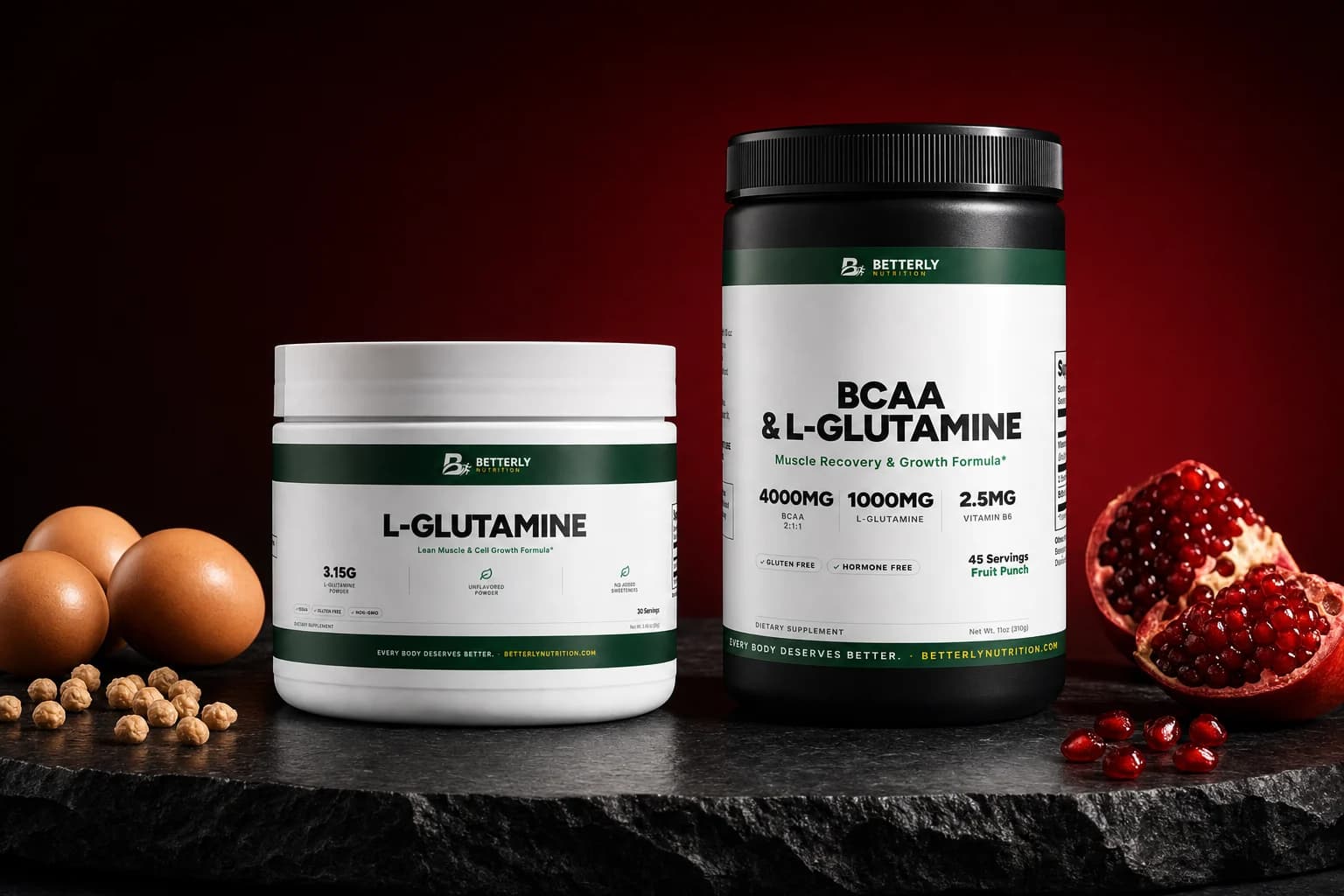
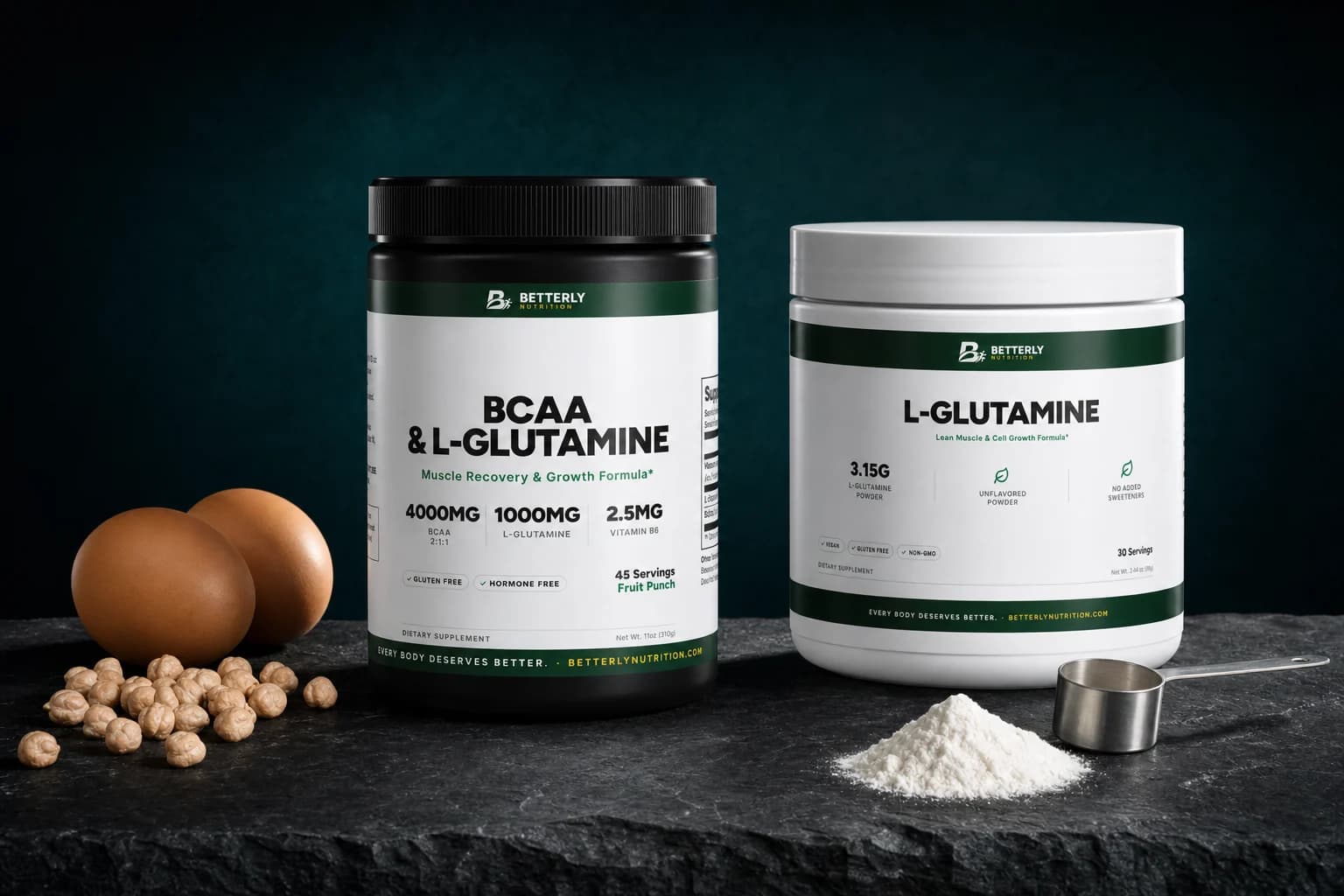
From our shop: L-Glutamine Powder — 3.15 g of L-glutamine per 1-scoop (3.3 g) serving, with silicon dioxide as the only other listed ingredient, labeled vegan, gluten free and non-GMO.
Are you double counting glutamine with a BCAA powder?
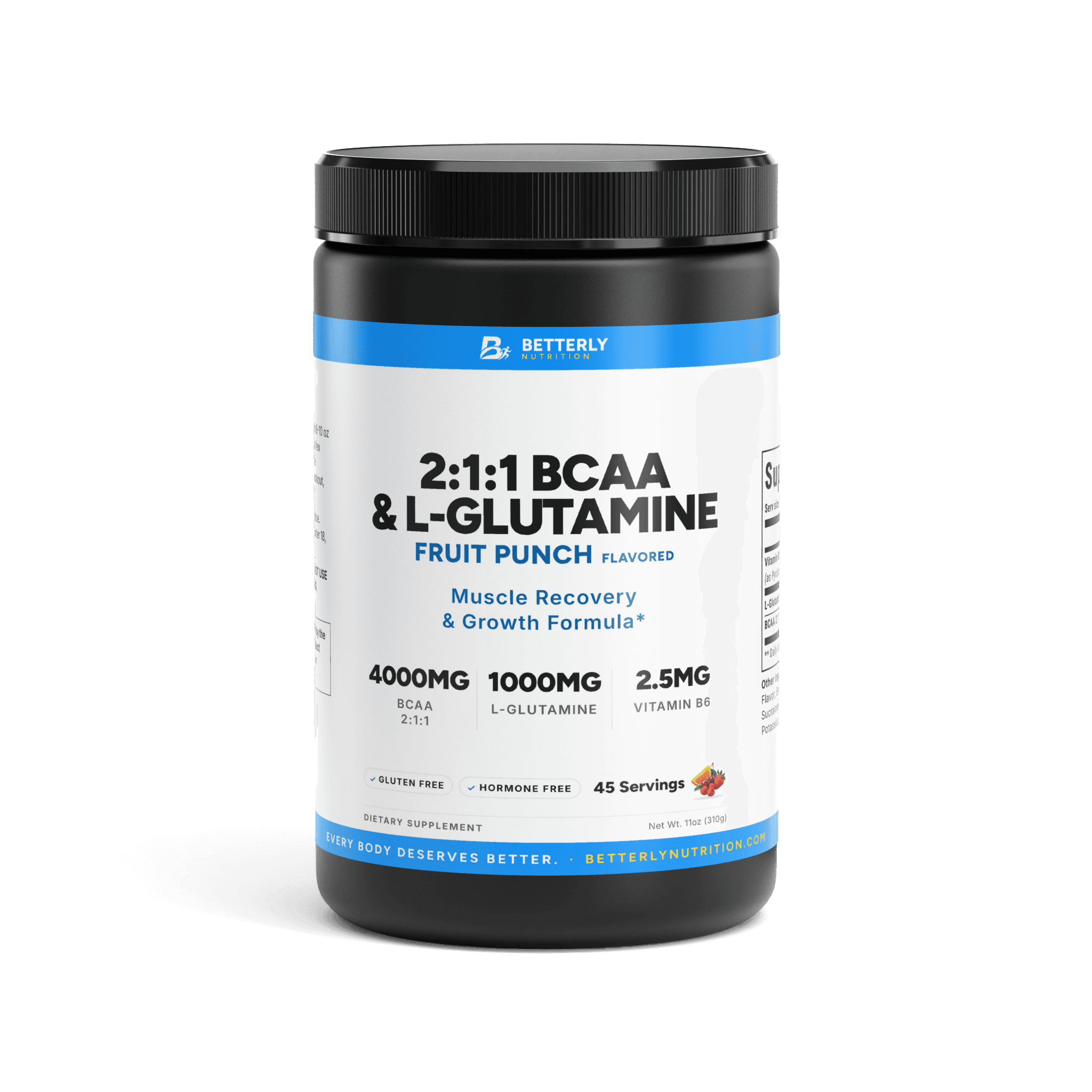
If you also use Betterly's 2:1:1 BCAA & L-Glutamine Powder, yes: each 1/2-scoop (6.5 g) serving adds 1,000 mg of L-glutamine to your day.
It's easy to miss, even though the number is printed on the front of the tub. One tub looks like a plain unflavored powder and the other like a flavored training drink, but your body just sees glutamine from both. Both flavors of our BCAA powder list the same 1,000 mg.
| Label detail | L-Glutamine Powder | 2:1:1 BCAA & L-Glutamine Powder (Fruit Punch) |
|---|---|---|
| Serving size | 1 Scoop (3.3 g) | 1/2 scoop (6.5 g) |
| L-glutamine per serving | 3.15 g | 1,000 mg |
| Other actives on the panel | None | 4,000 mg BCAA 2:1:1, 2.5 mg vitamin B6 |
| Sweeteners listed | None | Sucralose, acesulfame potassium |
| Servings per container | 30 | 45 |
Gram for gram, the plain powder is the bigger source: one scoop holds more than three times the L-glutamine of a BCAA serving. The BCAA label doesn't say how many servings to have in a day. It says to mix 1/2 scoop in 8-10 oz of cold beverage, best taken pre-workout, post-workout or between meals. So count every serving you mix.
Each 1/2-scoop (6.5 g) serving of the BCAA powder also carries 2.5 mg of vitamin B6, listed at 147% of the Daily Value, so check any multivitamin for a B6 row too. And while ODS notes your body makes some glutamine from BCAAs, no label can tell you how much. Count only the printed milligrams.
If the BCAA drink is part of your training, our guide on what to take after a workout shows where it fits, and our guide to taking BCAAs and glutamine together covers the pairing itself.
From our shop: 2:1:1 BCAA & L-Glutamine Powder (Fruit Punch) — a fruit punch training drink sweetened with sucralose and acesulfame potassium, with 1,000 mg of L-glutamine and 4,000 mg of BCAA 2:1:1 in each 1/2-scoop (6.5 g) serving.
How should you take L-Glutamine Powder, according to the label?
The label's suggested use is 1 scoop (3.3 g) of L-Glutamine Powder with a beverage you like, 1 to 3 times daily, or as directed by a healthcare professional.
That last clause matters. The ODS page Dietary Supplements: What You Need to Know explains that the serving size is the maker's suggestion and that a clinician who knows you may land on another amount. If yours gives you a number, follow it.
A few habits keep the numbers honest:
- Start at the bottom of the label's range. One scoop a day is still label use, and it's the gentlest way to learn how glutamine sits with you.
- Level the scoop. A heaped scoop quietly changes every figure in the tables above.
- Count your other sources first. Before a second or third scoop, add in any BCAA drink or blend that lists L-glutamine.
- Follow the storage line. The label asks for a cool, dry spot, and it rules out any tub whose seal is broken or gone.
The label says nothing about timing or food. Any empty-stomach rule you've read elsewhere is a convention, and it isn't part of our label's directions.
Is L-glutamine good for you if you already eat enough protein?
For most healthy adults, L-glutamine is optional. Your body makes it, and protein foods already supply about 3 to 6 g a day, according to ODS.
MedlinePlus, run by the National Library of Medicine, lists glutamine among the nonessential and conditionally essential amino acids. Nonessential means your body can make it without food supplying it. Conditionally essential means it's usually not needed from outside, except at times of illness or stress. The ODS immune function sheet agrees: your body makes enough except in rare situations, such as critical illness in a hospital or recovery from major surgery. Both of those are hospital situations, handled by a medical team.
For training, ODS is plain. Its exercise sheet says the few studies on glutamine for strength training and recovery found no effect or only a small benefit.
You probably don't need a glutamine supplement if:
- You eat protein foods most days and have no specific reason to add more.
- You're hoping for a performance edge, which ODS finds little evidence for.
- You already drink a BCAA powder that lists L-glutamine.
- Even one scoop leaves you gassy, bloated or queasy.
Our powder doesn't change that picture. It's simply a measured way to add glutamine if you want to. If digestion is the real goal, the habits in our gut health basics guide come first, and our gut health and digestion collection shows the other options we carry.
Who should get a provider's okay before trying L-glutamine?
Check with a physician before L-glutamine if you're pregnant, nursing, under 18 or living with a medical condition, as both glutamine labels say. The same goes if you take prescription medicine or have surgery coming up.
The two tubs carry an identical caution, so switching to the BCAA drink doesn't take anyone off the list. Some groups have glutamine details worth raising:
- Under 18: the BCAA drink is the one that's easy to overlook. It's flavored like fruit punch and looks like any training drink, yet its label carries the same under-18 line as the plain powder.
- Managing a medical condition: a label can't see your health history, so bring the real numbers. That's 3.15 g per scoop, 9.45 g on a full label day, and 1,000 mg more for each BCAA serving.
- Surgery on the calendar: ODS brings up major surgery only as a rare hospital setting, where the glutamine studied was given by IV or tube feeding. Your surgical team should hear about your tub, and any BCAA drink, at your pre-op visit.
Pregnancy, nursing and prescription medicine each get their own answer in the FAQ below.
FAQ: L-glutamine safety
Is 10 g of L-glutamine a day too much?
Ten grams of L-glutamine a day is more than either of our labels reaches alone, but it's well under the research amounts ODS describes. Its exercise sheet says studies reported no side effects at up to 45 g a day for several weeks in adults. Three scoops of L-Glutamine Powder come to 9.45 g by our math, so you'd pass 10 g only by adding a BCAA serving, for 10.45 g. If that stacked day brings gas or bloating, cut the extra source first.
Can L-glutamine cause bloating?
Yes, L-glutamine can cause bloating. It's one of the six glutamine side effects the NIH Office of Dietary Supplements lists, alongside gas and burping. If you use both of our powders, note which one came first. The plain powder lists only silicon dioxide next to the glutamine, while the BCAA drink also lists citric acid, fruit punch flavor, two sweeteners and more. With fewer other ingredients in play, the plain tub is the simpler one to test by itself.
Can you take L-glutamine while pregnant or nursing?
Take L-glutamine while pregnant or nursing only with your physician's okay, because both of our glutamine labels say to consult a physician first. The ODS glutamine entries we cite don't mention pregnancy or nursing, but the ODS sheet Dietary Supplements: What You Need to Know advises caution with supplements beyond a standard prenatal if you're pregnant or nursing, since many haven't been well tested for safety in that group. Bring both panels: 3.15 g of L-glutamine per scoop of L-Glutamine Powder and 1,000 mg per 1/2-scoop serving of the BCAA powder.
Does L-glutamine interact with medications?
No interactions between L-glutamine and medications have been reported, according to the NIH Office of Dietary Supplements. That describes what's been reported so far, and ODS doesn't say every drug pairing has been checked. When a pharmacist asks what supplements you take, name both tubs. A flavored training drink doesn't sound like a supplement, but the BCAA powder's 1,000 mg of L-glutamine per 1/2-scoop (6.5 g) serving belongs on that list too.
How long does a tub of L-Glutamine Powder last?
A tub of L-Glutamine Powder lasts 10 to 30 days, since it holds 30 servings. That's 30 days at one scoop a day, 15 days at two and 10 days at three. The spread doubles as a quick intake check. If a tub runs out in under two weeks, you're averaging more than two scoops a day, near the top of the label's range. If your stomach has been unsettled too, that pace is the first thing to look at.
Sources
- Glutamine, in Dietary Supplements for Immune Function (Fact Sheet for Consumers) (NIH Office of Dietary Supplements)
- Dietary Supplements for Exercise and Athletic Performance, Fact Sheet for Consumers (NIH Office of Dietary Supplements)
- Dietary Supplements: What You Need to Know, Fact Sheet for Consumers (NIH Office of Dietary Supplements)
- Amino Acids (MedlinePlus Medical Encyclopedia, National Library of Medicine)
If this left you looking for somewhere to start, read L-glutamine powder with 3.15 g per scoop — its amounts per serving are listed on the page. For the practical questions this raises, how dosing, sourcing and subscriptions work is answered in one place.