On this page
- What is L-glutamine, exactly?
- Why your gut lining cares about glutamine
- What the research suggests (and what it doesn't)
- L-glutamine powder vs capsules: choosing a form
- How much L-glutamine per day?
- When to take L-glutamine — and what to pair it with
- Who tends to reach for L-glutamine
- Key takeaways
- FAQ: L-glutamine and gut health
- Sources
L-glutamine has one of the stranger résumés in the supplement aisle. For decades it lived in gym bags next to creatine and protein powder — and now it's just as likely to show up in someone's morning gut routine. This guide looks at L-glutamine for gut health with clear eyes: what the amino acid actually does in your body, why the cells lining your intestines are unusually interested in it, what the research honestly suggests, and how to choose between powder and capsules if you decide to try it.
One thing up front: glutamine is inexpensive, well-tolerated by most people, and backed by a genuinely interesting mechanism — and the human research on everyday gut benefits is still early and mixed. Both of those things are true at once, and this guide holds onto both.
What is L-glutamine, exactly?
L-glutamine is an amino acid — one of the building blocks your body uses to make proteins. It's also the most abundant free amino acid in your body, circulating in your blood and stored in your muscles in greater quantities than any other.
Your body makes glutamine on its own, which is why textbooks class it as "non-essential." Researchers sometimes call it "conditionally essential" because in rare situations the body's needs can outrun what it makes. According to the NIH Office of Dietary Supplements, your body makes enough glutamine to meet your needs except under rare conditions, such as intensive hospital care or recovery from major surgery. You also get glutamine from food: meat, eggs, dairy, tofu, and some grains all contain it.
A supplement simply gives you the free-form amino acid by itself, usually as an unflavored powder, so you can take a measured amount without planning your whole plate around it.
Why your gut lining cares about glutamine
Here's the part that moved glutamine from the gym into the gut conversation.
The lining of your small intestine is one of the busiest tissues you own. It's a single layer of cells, replaced roughly every few days, doing two jobs at once: absorbing nutrients in, and acting as a barrier that keeps everything else where it belongs.
All that constant rebuilding takes fuel — and the cells doing the work (enterocytes, if you want the technical name) have an unusual preference. Rather than running mainly on glucose the way most tissues do, they use glutamine as a primary energy source, and they can pull it directly from the gut as food passes through. Research also suggests glutamine plays a role in the tight junctions — the protein "seals" between those cells that help maintain the intestinal barrier.
So the theory almost writes itself: the gut lining runs partly on glutamine, therefore giving it a steady supply supports the gut lining. It's a reasonable theory. Whether it plays out in everyday supplement use is where an honest guide has to slow down.
What the research suggests (and what it doesn't)
The case for L-glutamine for gut health has three layers, and they don't all say the same thing.
The mechanism is solid. That intestinal cells preferentially burn glutamine is well established in lab and animal research. Nobody seriously disputes that the gut lining is one of the body's biggest consumers of this amino acid.
Some human findings are encouraging. Much of the strongest human data comes from hospital nutrition settings, where glutamine has a long history — a very different situation from a healthy adult stirring powder into water at home.
The overall picture is mixed. When researchers pooled clinical trials on glutamine and intestinal permeability — a lab measure of how easily substances pass through the gut wall — in a recent meta-analysis, the combined effect across studies wasn't significant. Some individual trials found improvements in barrier markers; others found little or nothing. Different doses, durations, and study populations make the literature genuinely hard to summarize, which is usually a sign a field is still young.
What the research doesn't support is the idea that glutamine will dramatically change your digestion on its own, or that it can stand in for the fundamentals. Fiber, a wide variety of plants, sleep, movement, and managed stress still do the heavy lifting — our gut health basics guide walks through that foundation in plain language. Glutamine is best understood as a low-risk, mechanistically sensible addition on top of those basics, taken with honest expectations.
L-glutamine powder vs capsules: choosing a form
Glutamine is one of the few supplements where form is mostly a practical question, not a quality question. What differs between powder and capsules is mostly the experience:
- Powder makes gram-level amounts easy. Glutamine servings are measured in grams, not milligrams — and fitting grams into capsules means swallowing quite a few of them. Powder is nearly tasteless, dissolves readily in water or a smoothie, costs less per serving, and lets you measure exactly what you're taking.
- Capsules win on convenience. No scoop, no mixing, easy to travel with. The trade-off is capsule count and price per gram.
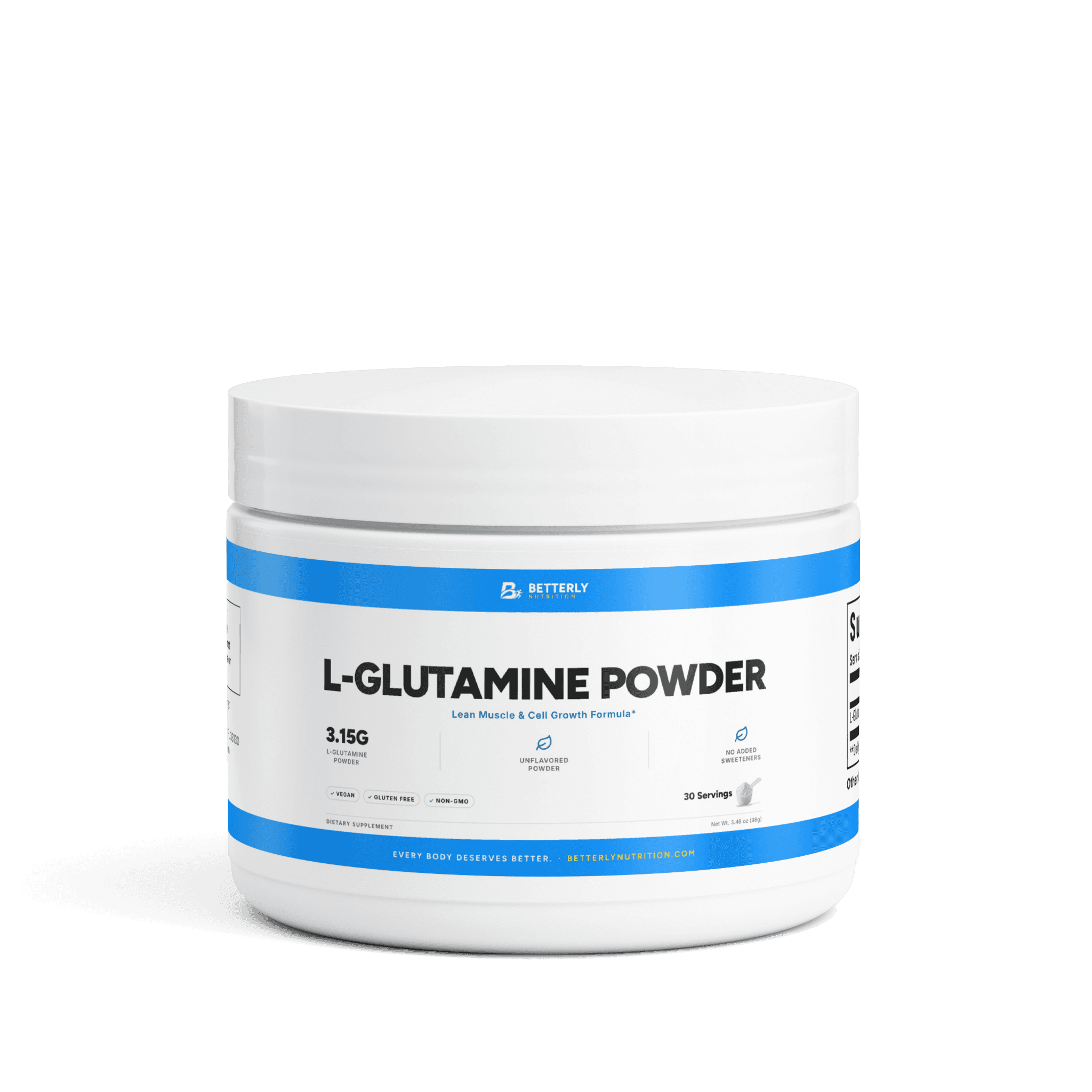
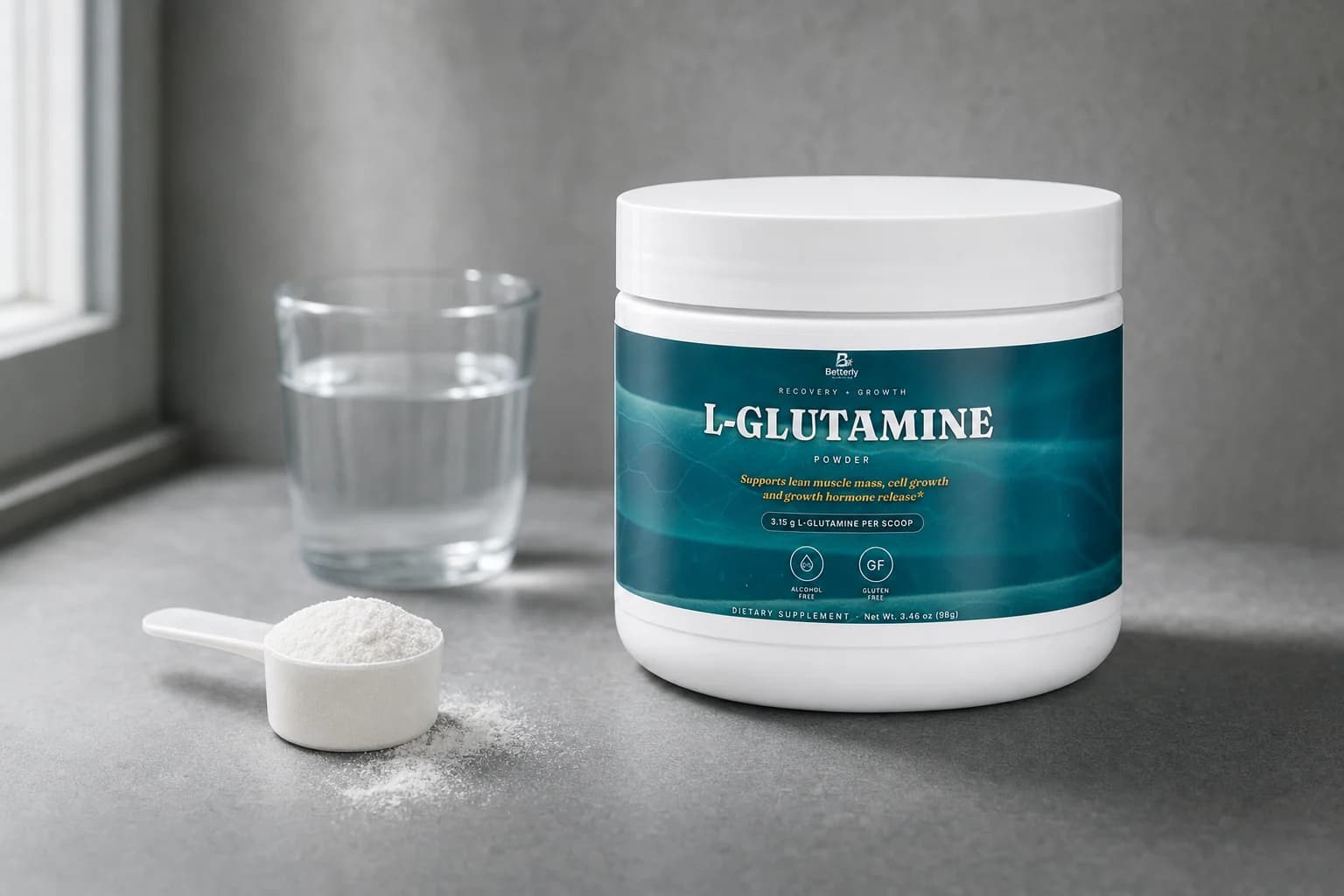
For a single amino acid taken daily, powder is the format most people land on. Our L-Glutamine Powder takes the plainest possible approach. It's an unflavored powder with one active on its Supplement Facts panel: 3.15 g of L-glutamine per 1 scoop (3.3 g) serving, with silicon dioxide as the only other ingredient. It's positioned for muscle recovery and gut support — with the dose printed right on the page, because you shouldn't have to squint at a label photo to find out what you're buying.
One practical note: the label's suggested use is to mix it with a beverage of choice.
How much L-glutamine per day?
This is where labels and research part ways, and it's worth being straightforward about it.
In research settings, daily amounts have varied widely, and many studies have used far more than a single label serving. For context, according to the NIH Office of Dietary Supplements, adults already get about 3 to 6 grams of glutamine a day from protein-containing foods such as meat, poultry, fish, eggs, dairy products, and legumes. The label's suggested use for our L-Glutamine Powder is 1 serving taken 1 to 3 times daily with a beverage of choice, and each 1 scoop (3.3 g) serving provides 3.15 g of L-glutamine.
A sensible approach:
- Start with the label serving. More isn't automatically better, and consistency beats quantity for an amino acid your gut uses daily.
- Be consistent. If glutamine does anything noticeable for you, expect it to be subtle rather than dramatic.
- Don't escalate on your own. If you're curious about the larger amounts used in studies, that's a conversation for your healthcare provider — especially if you take medication, are pregnant or nursing, are under 18, or have an ongoing health concern.
Glutamine is generally well tolerated at label servings. According to the NIH Office of Dietary Supplements, side effects can include bloating and gas, and they're more likely at higher doses. If you notice them, cut back to one serving a day or stop, and check with your healthcare provider.
When to take L-glutamine — and what to pair it with
The suggested use on our L-Glutamine Powder label is 1 serving taken 1 to 3 times daily with a beverage of choice. It doesn't set a time of day, so pick a slot you'll stick with; taking it consistently matters more than exact timing.
Because glutamine addresses only one corner of gut health, it pairs naturally with a couple of other tools:
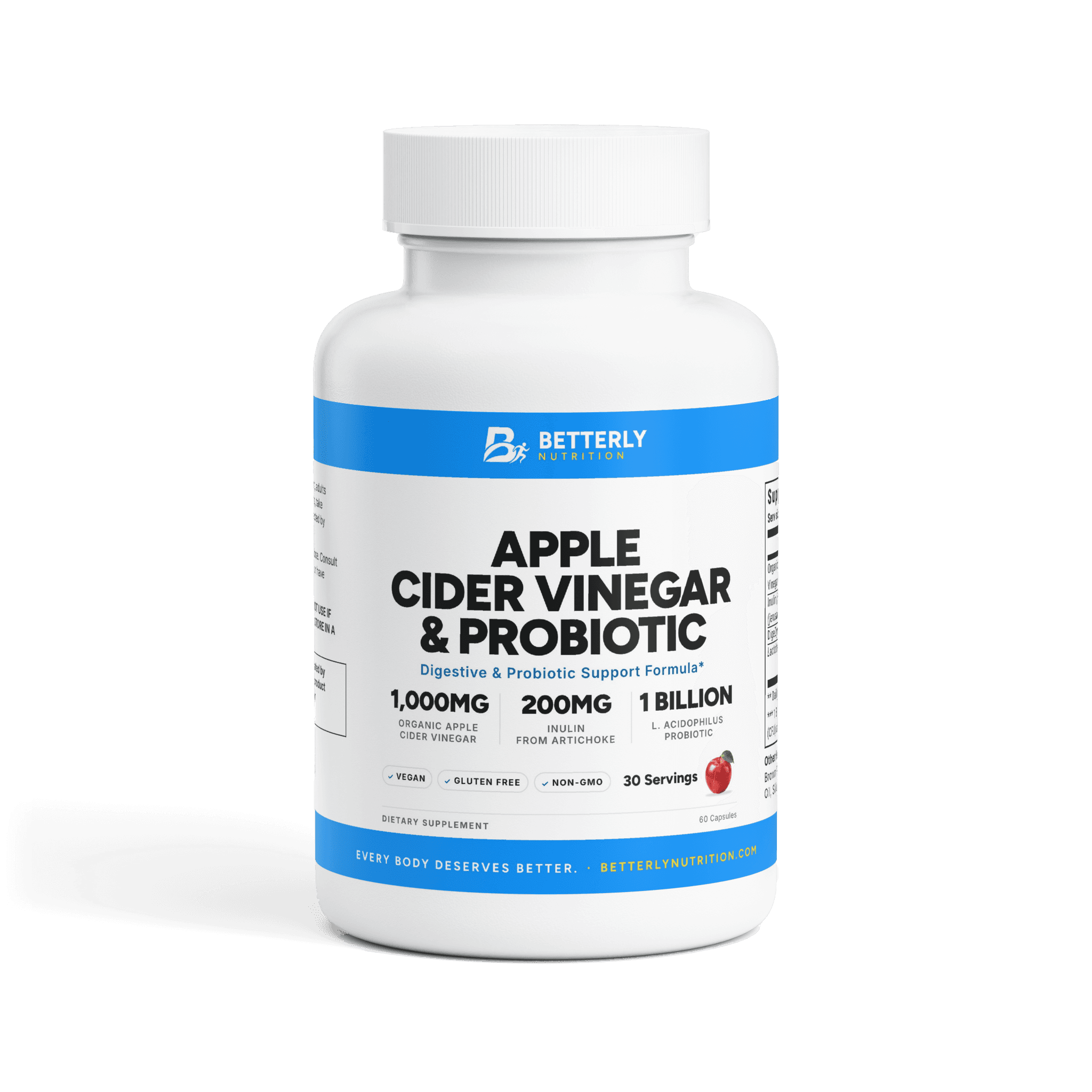
- A probiotic covers the microbial side of the equation while glutamine covers fuel for the lining itself. Our Apple Cider Vinegar & Probiotic Capsules combine apple cider vinegar with a probiotic to support healthy digestion — and if you're comparing options, Probiotics 101 explains what to actually look for on a label. Curious about the apple cider vinegar side? We cover timing in when to take apple cider vinegar capsules.
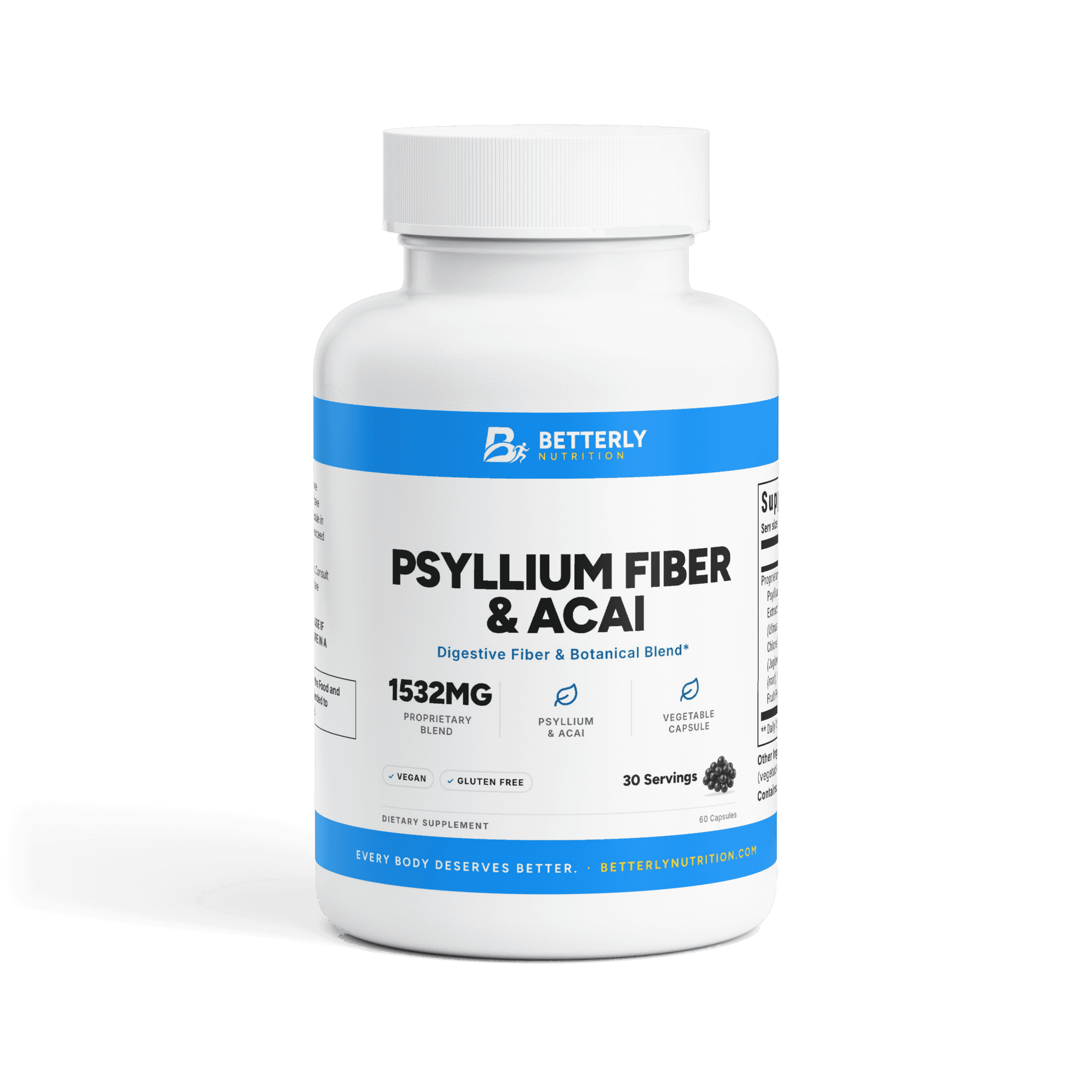
- Fiber remains the most underrated gut supplement there is — it's what feeds the microbes downstream. Our guide to choosing a fiber supplement for regularity sorts the options, and Psyllium Fiber & Acai Capsules are our take on digestive regularity.
- A greens powder is a simple way to widen your plant variety on busy days. Barley Grass & Spirulina Greens Powder brings spirulina, barley grass, and 20+ plant ingredients to the everyday-nutrition side of the picture.
None of these are mandatory stacking. Pick the gap you actually have.
Who tends to reach for L-glutamine
Three groups show up again and again:
People who train hard. This is glutamine's original crowd. It has a long history in training routines, and some lifters and runners fold it into a gut routine as well. If you're building a training stack from scratch, creatine, like our Creatine Monohydrate Powder, has considerably stronger performance evidence and pairs fine alongside glutamine; our creatine for beginners guide is the place to start.
People building a gut routine who want single ingredients. Gut-health blends can be kitchen sinks. A one-active powder lets you add one variable at a time and actually notice what changes — the same start-low-and-single logic we recommend for every routine.
People who value knowing exactly what they're taking. Glutamine is about as transparent as supplements get: one amino acid, one number on the label. If that's your style, browse our gut health and digestion collection and compare each product's amounts per serving before you choose.
And a quick flag on who should check with a provider first: anyone pregnant or nursing, anyone under 18, anyone taking medication, and anyone managing an ongoing health concern. Amino acid metabolism is personal, and a two-minute conversation beats guessing.
Key takeaways
- L-glutamine is the most abundant free amino acid in your body, made on demand and topped up by food — a supplement just adds a measured, convenient amount.
- Your gut lining is a major glutamine consumer. The cells lining the small intestine use it as a primary fuel, and research suggests it plays a role in helping maintain the intestinal barrier.
- The human evidence is early and mixed. Pooled trials on gut permeability didn't find a consistent overall effect. Expect subtle support, not a transformation.
- Powder beats capsules on practicality for gram-level servings.
- Take it consistently, following the label's suggested use (1 serving, 1 to 3 times daily, with a beverage of choice), and start with the label serving rather than research-range amounts.
- It's a supporting player. Fiber, plants, sleep, and movement remain the foundation of gut health; glutamine adds to that foundation, it doesn't replace it.
FAQ: L-glutamine and gut health
Does L-glutamine help with bloating?
There's no strong research showing glutamine settles occasional bloating directly, and a few people actually notice mild gas or bloating when taking it. If everyday digestive comfort is your main goal, fiber, eating pace, and a probiotic routine are better-supported starting points.
Can I take L-glutamine every day?
Most people take it daily — that's the standard pattern, since your gut uses glutamine continuously. Stick to the label serving, and loop in your healthcare provider if you take medication, are pregnant or nursing, are under 18, or are managing a health concern.
Should I take L-glutamine on an empty stomach?
Our L-Glutamine Powder label doesn't call for an empty stomach. Its suggested use is 1 serving taken 1 to 3 times daily with a beverage of choice, and it doesn't set a time of day. So choose whatever time you'll remember and stick with it; consistency matters more than exact timing.
Does L-glutamine break a fast?
It's an amino acid, so strict fasters may prefer to take it during their eating window. The suggested use on our L-Glutamine Powder label is 1 serving taken 1 to 3 times daily with a beverage of choice, and it doesn't address fasting either way.
Can I take L-glutamine with creatine or protein?
Yes. They do different jobs, and there's no known conflict between them. Follow each product's label directions; they can go in the same daily routine. If you take medication or are managing a health concern, check with your healthcare provider before adding either one.
How do I know if L-glutamine is worth continuing?
There's no set timeline for L-glutamine, and its effects, where they show up, tend to be quiet. Keep expectations modest and take it consistently at the label serving. One advantage of a one-active powder is that the experiment is clean: if you don't notice a difference, it's easy to stop.
Sources
- Dietary Supplements for Exercise and Athletic Performance, Consumer Fact Sheet (NIH Office of Dietary Supplements)
- Dietary Supplements for Immune Function, Consumer Fact Sheet (NIH Office of Dietary Supplements)
If this left you looking for somewhere to start, read single-ingredient L-glutamine powder — its amounts per serving are listed on the page. For the practical questions this raises, how dosing, sourcing and subscriptions work is answered in one place.