On this page
- Key takeaways
- What's actually in Metamucil?
- Metamucil vs psyllium husk powder: what do the labels show?
- How much psyllium do you get in each dose?
- Metamucil vs psyllium husk capsules: how do they compare?
- Psyllium husk vs Benefiber: is it the same kind of fiber?
- Which should you buy: Metamucil, plain husk or a sachet?
- How do you take our psyllium sachet?
- When don't you need Metamucil or a psyllium supplement?
- Who should check with a healthcare provider first?
- FAQ: Metamucil vs psyllium husk
- Sources
The short answer: In the Metamucil vs psyllium husk question, the fiber is the same. Metamucil's ingredient list starts with psyllium husk, so the real differences sit around it: grams per dose, sweetener, flavor, color and format. One rounded teaspoon of Metamucil Sugar-Free Orange Smooth counts 3 g of dietary fiber and adds maltodextrin, aspartame and Yellow 6. Plain husk is only husk, and it usually costs the least per gram.
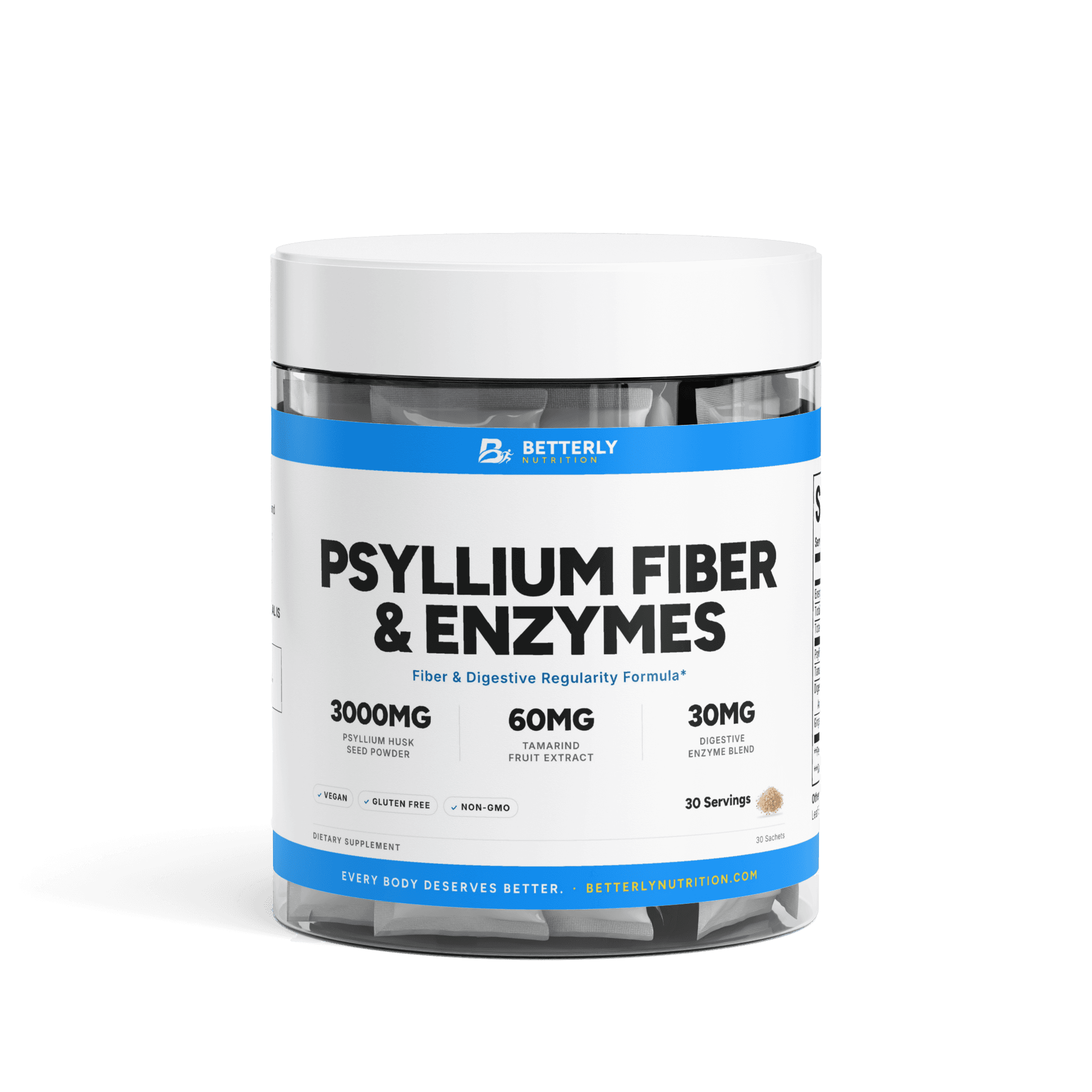
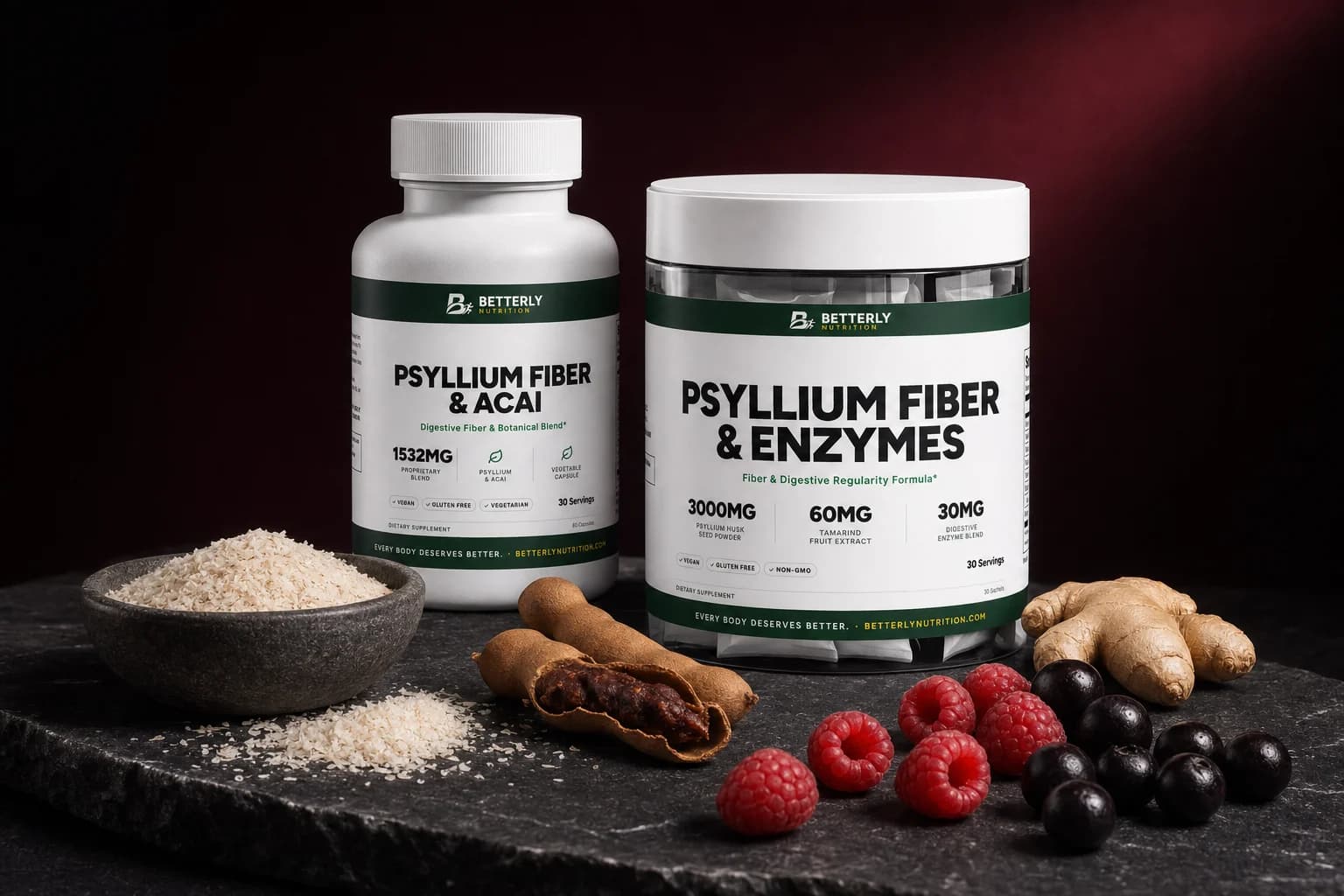
We sell Psyllium Fiber & Digestive Enzyme Powder, a tub of single-serve sachets, plus a psyllium capsule. We don't sell Metamucil or Benefiber, which gives us a reason to favor our own, so we've kept every claim checkable. Each competitor number below comes from that brand's own label or product page, opened on September 23, 2026. Metamucil is a Procter & Gamble brand, and we aren't affiliated with it or with Benefiber.
Key takeaways
- Metamucil's fiber is psyllium husk, the seed coat of the Plantago ovata plant, so switching brands changes the extras, not the fiber.
- Plain psyllium husk is usually the cheapest way to buy psyllium per gram, because you pay for one ingredient and no packaging extras.
- Benefiber Original is wheat dextrin, a different fiber that dissolves into drinks, not a psyllium product.
- Our sachet's label and Metamucil's powder label both set a liquid amount and a gap from medicines, but the label on our Psyllium Fiber & Acai Capsules sets neither, so follow MedlinePlus's 8-ounce minimum with any psyllium.
What's actually in Metamucil?
The two Metamucil supplement powders we checked are psyllium husk plus maltodextrin (a carbohydrate), flavor, sweetener and color. The Metamucil capsules we checked list only psyllium husk and gelatin.
- Metamucil Sugar-Free Orange Smooth: psyllium husk, maltodextrin, citric acid, natural and artificial orange flavor, aspartame, Yellow 6.
- Metamucil Premium Blend (orange): psyllium husk, maltodextrin, citric acid, natural orange flavor, stevia, and paprika extract and turmeric for color.
- Metamucil Fiber Capsules: psyllium husk, gelatin.
Psyllium husk is the outer coat of the seed. MedlinePlus explains that soluble fiber "attracts water and turns to gel during digestion," and it names psyllium as a common fiber supplement that contains it. That gel is why a psyllium drink left on the counter turns thick.
The FDA's Questions and Answers on Dietary Fiber lists psyllium husk among the isolated fibers that count as dietary fiber on a label. Orange tub or plain bag, it's the same recognized ingredient.
We left out Metamucil's powder labeled as an over-the-counter drug, listed on the National Library of Medicine's DailyMed, so this stays supplement to supplement.
Metamucil vs psyllium husk powder: what do the labels show?
Metamucil vs psyllium husk powder comes down to what each label counts, what sweetens it and how much liquid it asks for. Here are two Metamucil powders next to our sachet.
| Per serving | Metamucil Sugar-Free Orange Smooth | Metamucil Premium Blend | Our Psyllium Fiber & Digestive Enzyme Powder |
|---|---|---|---|
| Serving size | 1 rounded tsp (5.8 g) | 1 rounded tsp (5.7 g) | 1 sachet |
| Main number | 3 g dietary fiber (2 g soluble) | 3 g dietary fiber (2 g soluble) | 3,000 mg psyllium husk seed powder |
| Calories | 15 | 15 | 6 kcal |
| Sweetener | Aspartame | Stevia | Stevia leaf extract |
| Added color | Yellow 6 | Paprika extract, turmeric | None listed |
| Maltodextrin | Listed | Listed | Not listed |
| Other actives | None | None | Tamarind, enzyme blend, ginger |
| Liquid per dose | 8 oz or more | 8 oz or more | 6.8 fl oz (200 mL) |
The fiber is shared, and the extras aren't. If stevia is your reason for looking past Metamucil, know that Metamucil already makes a stevia version, Premium Blend.
Our sachet is raspberry flavored and skips maltodextrin and added color.
How much psyllium do you get in each dose?
Our sachet lists 3,000 mg of psyllium husk seed powder per 1-sachet serving, while Metamucil lists 3 g of dietary fiber per rounded teaspoon. Those two figures measure different things.
A husk-weight number tells you how much psyllium went in. A dietary-fiber number tells you how much of the serving the maker counts as fiber. Metamucil's panel doesn't print the husk's weight, and ours doesn't print a fiber row, so you can't convert one into the other from the packaging alone.
The daily limits differ by label, too:
- Metamucil powder: for digestive health, 1 rounded teaspoon up to 3 times per day, starting at one serving a day.
- Our sachet: 1 to 2 sachets daily, or 3,000 to 6,000 mg of psyllium husk.
- Plain husk: whatever its own label says.
Each set of directions assumes it's your only psyllium product, so don't run two at once.
Metamucil vs psyllium husk capsules: how do they compare?
Metamucil's capsule serving is 5 capsules with 2 g of dietary fiber, and its label allows 2 to 5 capsules up to 4 times a day. Capsules give fewer grams per swallow in exchange for no mixing.
The Metamucil capsule label also lists gelatin, so skip it if you avoid animal-derived ingredients. It says to swallow 1 capsule at a time, upright, with at least 8 oz (a full glass) of liquid, and not to take the capsules if you have difficulty swallowing.
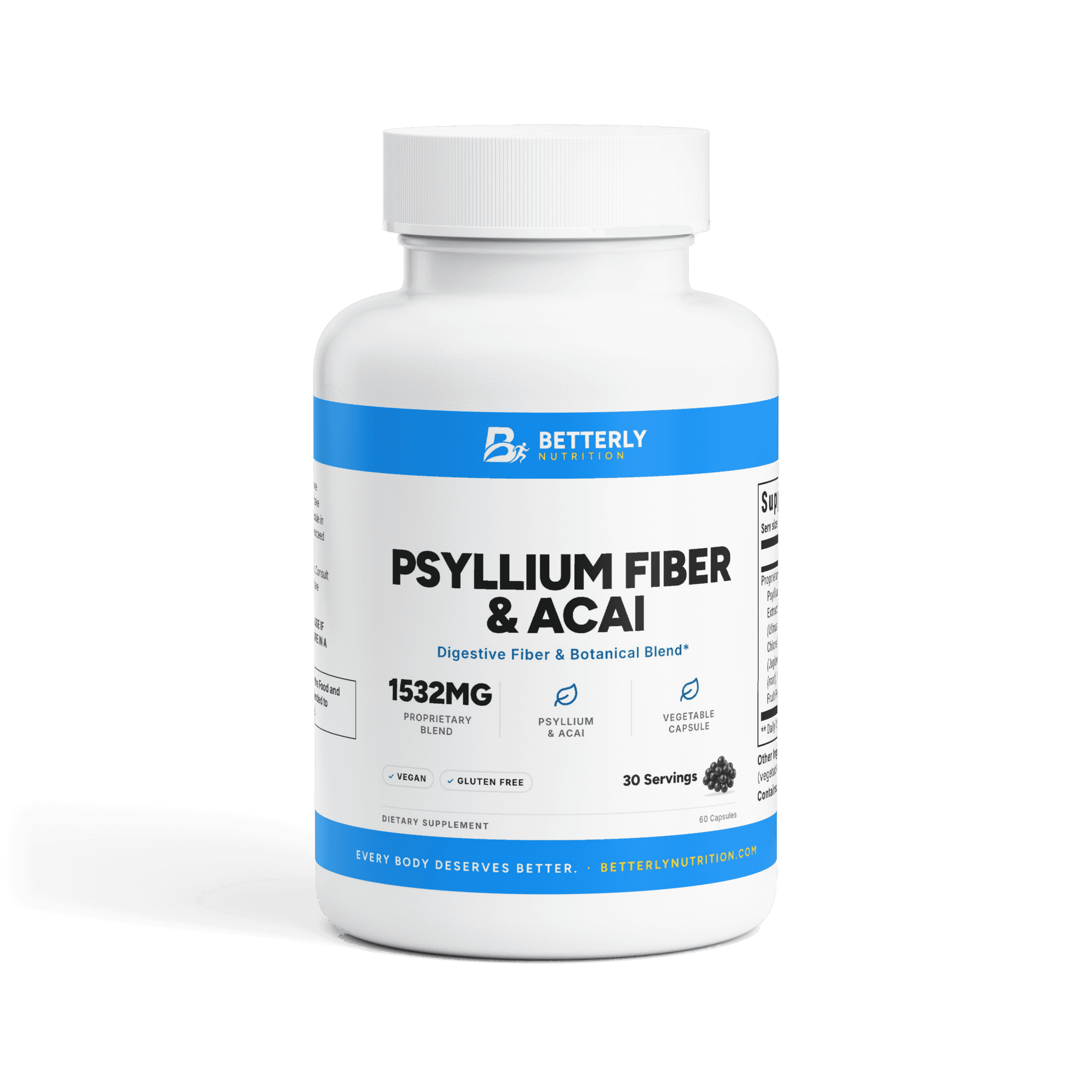
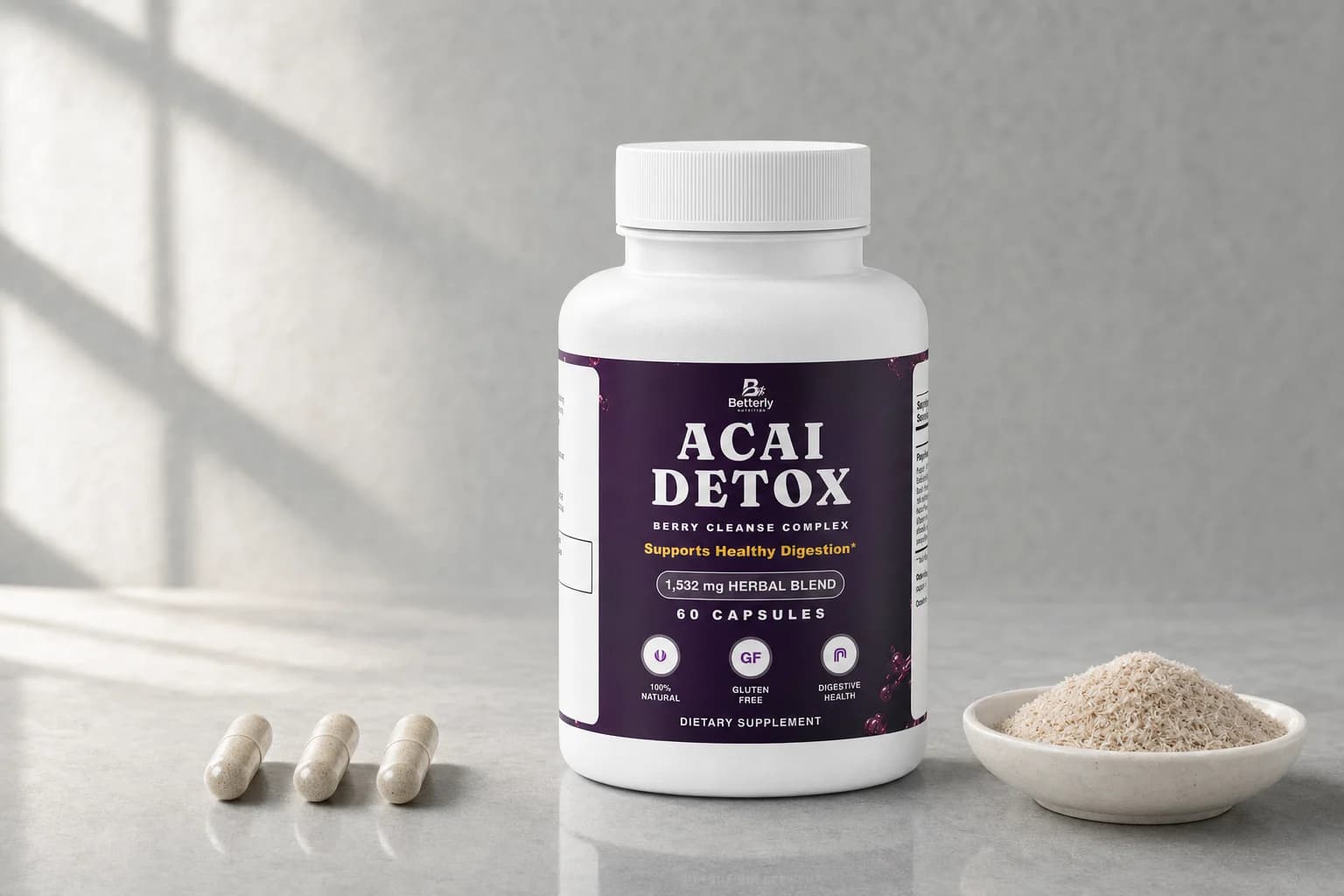
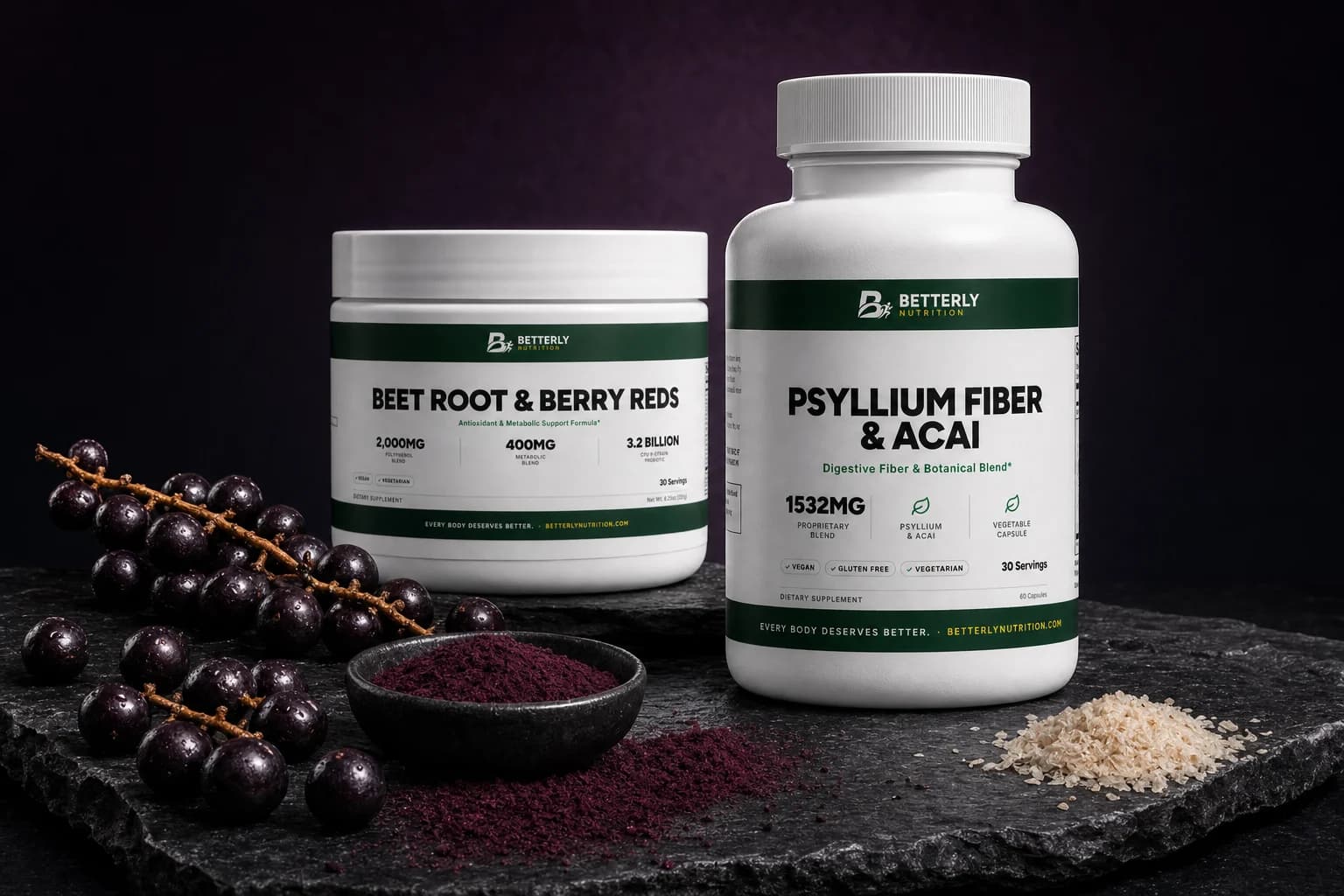
Our capsule is a different kind of product. Psyllium Fiber & Acai Capsules hold a 1,532 mg proprietary blend per 2-capsule serving. The blend lists psyllium powder (husk) first, then acai berry extract, inulin, slippery elm bark, aloe ferox leaf powder and six more ingredients. Because it's a blend, the label doesn't say how much of the 1,532 mg is psyllium.
That aloe entry reads "Alion 18%" on the panel, which we read as 18% aloin, a compound found in aloe latex. NCCIH notes that taking aloe latex by mouth can cause abdominal pain, cramps and diarrhea, and that overuse may raise the risk of side effects from heart medicines such as digoxin, so ask your provider before trying this capsule.
Our capsule label also gives no liquid amount and no gap from medicines. MedlinePlus says "you must drink at least 8 ounces (240 milliliters) of liquid when you take it," so follow that with any psyllium capsule, ours included.
If you want a stated fiber number from a capsule, Metamucil's capsule prints 2 g of dietary fiber per 5 capsules, and a single-ingredient psyllium capsule usually prints its husk weight. Ours prints neither for psyllium alone. It suits someone who wants psyllium inside a wider botanical formula. It contains tree nuts (black walnut hull), and the label caps it at two capsules a day, one during the day and one in the evening.
For the wider format decision, our guide to psyllium husk capsules vs powder covers texture, travel and cost.
From our shop: Psyllium Fiber & Acai Capsules — a 1,532 mg proprietary blend per 2-capsule serving, with psyllium husk powder listed first, in vegan vegetable capsules.
Psyllium husk vs Benefiber: is it the same kind of fiber?
No. Benefiber Original is made from wheat dextrin, while psyllium husk comes from a seed coat, so the two behave very differently in water.
Benefiber's own product page says each 4-teaspoon serving has 6 g of dietary fiber. You stir it into 4 to 8 oz of any drink or soft food, hot or cold, until it dissolves.
The practical difference is texture. Psyllium's gel is why Metamucil says to drink promptly and our label says to consume the sachet immediately. Wheat dextrin sells on the opposite trait: it dissolves and stays thin, so it can go into coffee or soup.
If you want a fiber you can't taste or feel, wheat dextrin is built for that. Our guide to choosing a fiber supplement for regularity compares psyllium with wheat dextrin, inulin and methylcellulose.
Which should you buy: Metamucil, plain husk or a sachet?
Plain psyllium husk usually costs the least per gram, Metamucil is the familiar flavored tub, and single-serve sachets trade some cost for no measuring. Pick the one you'll keep taking.
| If you want | Look at | The trade-off |
|---|---|---|
| The lowest cost per gram | Plain psyllium husk powder | No flavor, thickens fast |
| A flavored tub you know | Metamucil powder | Maltodextrin, sweetener, color |
| Premeasured stevia servings | Our psyllium sachets | Costs more per gram than plain husk |
| No mixing at all | Psyllium capsules | Several capsules for a few grams |
| A fiber that dissolves clear | Benefiber (wheat dextrin) | Not psyllium, doesn't gel |
No option wins every row. Price favors plain husk, habit favors whatever you'll drink, and texture decides between psyllium and wheat dextrin.
For your own cost check, compare like with like. Our tub holds 30 sachets at 3,000 mg each, or 90 g of psyllium husk, so divide its price by 90 and a plain bag's price by its husk grams. Metamucil prints fiber grams instead, and the two numbers aren't interchangeable, so compare Metamucil by cost per serving at each label's own dose.
We'll say it plainly: a plain bag of husk will almost always beat our sachets on that math. With us, you're paying for sealed single servings, the raspberry flavor and the tamarind, enzymes and ginger. If none of that matters to you, buy the plain bag.
From our shop: Psyllium Fiber & Digestive Enzyme Powder — 3,000 mg of psyllium husk seed powder per sachet, with tamarind, a 30 mg enzyme blend and ginger, sweetened with stevia leaf extract.
How do you take our psyllium sachet?
The Psyllium Fiber & Digestive Enzyme Powder label says to mix 1 sachet with 6.8 fl oz (200 mL) of water and drink it immediately. Take it 1 to 2 times daily, away from meals.
- Empty one sachet into 200 mL (6.8 fl oz) of water and stir.
- Drink it right away, before it thickens.
- Follow it with a little more water to reach the 8 ounces (240 mL) MedlinePlus asks for with psyllium.
- Keep it away from meals and at least 2 hours apart from any medication, as the label directs.
- Start with one sachet a day. The label allows two, but there's no need to open at the maximum.
Per 1-sachet serving, the panel also lists 60 mg of tamarind fruit extract, a 30 mg digestive enzyme blend listing amylase, lactase, lipase and cellulase (sourced from fermented cereals), and 15 mg of ginger root extract. The label makes no separate promise for them, and neither do we. Our guide to digestive enzymes and probiotics explains what each enzyme acts on, and our gut health and digestion collection lists the related products in one place.
When don't you need Metamucil or a psyllium supplement?
You may not need any psyllium product if your meals already reach the 21 to 38 grams of fiber a day that MedlinePlus recommends for adults.
MedlinePlus's fiber overview gives that range and adds two practical notes: add fiber gradually over a few weeks, and drink plenty of fluids.
Other honest reasons to skip a purchase:
- Metamucil already works for you. Switching to us gets you a different sweetener and packaging, not a different fiber.
- You'd rather eat it. The MedlinePlus soluble fiber page lists oat bran, barley, nuts, seeds, beans, lentils and peas among its sources.
- Big glasses of water aren't realistic. Psyllium needs liquid, so talk that over with your provider first.
Who should check with a healthcare provider first?
If you take any medicine or find swallowing hard, ask a provider before you start psyllium. Pregnancy, nursing, being under 18 and managing a health condition are reasons to ask first, too.
Our sachet's caution goes further and tells everyone to consult a physician before use or when taking medication. The details:
- Medications. Metamucil's label and our sachet's label both say at least 2 hours apart from medicines, while our acai capsule label sets no gap. MedlinePlus names specific medicines that shouldn't be taken within 3 hours of psyllium, so bring your list to a pharmacist.
- Swallowing. Metamucil's capsule label warns that taking it without enough liquid may cause choking.
- Psyllium sensitivity. Metamucil's labels carry an alert for people sensitive to inhaled or ingested psyllium, and MedlinePlus advises not breathing in the powder while mixing.
- Age and tree nuts. Our sachet isn't intended for children under 12. Our acai capsule label wants anyone younger than 18 to talk to a physician, and it contains black walnut hull.
- Aloe. Our acai capsule's blend includes aloe ferox leaf powder, and NCCIH notes that aloe latex taken by mouth can cause abdominal cramps and diarrhea.
- Phenylalanine. Metamucil Sugar-Free Orange Smooth lists 25 mg of phenylalanine per teaspoon, from aspartame, which matters if you've been told to limit it.
FAQ: Metamucil vs psyllium husk
Is plain psyllium husk as good as Metamucil?
Plain psyllium husk is the same fiber Metamucil is built on, so the difference lies in the extras. Plain husk skips the maltodextrin, sweetener, flavor and color, and it usually costs less per gram. What it lacks is taste and convenience. If a flavored drink keeps you taking fiber daily, that's a fair reason to pay more.
Is Metamucil gluten free and vegan?
Metamucil's powders and capsules that we checked all print "gluten free" on their labels, but vegan is another story. The capsules list gelatin, which comes from animals, and the powder labels we opened make no vegan claim. Our Psyllium Fiber & Digestive Enzyme Powder claims vegan, gluten free and non-GMO, and our acai capsules claim vegan and gluten free.
Can you swap Metamucil for psyllium husk spoon for spoon?
No, a spoon of Metamucil and a spoon of plain psyllium husk don't hold the same amount of psyllium. A rounded teaspoon of Metamucil Sugar-Free Orange Smooth weighs 5.8 g, including maltodextrin, flavor and sweetener. Plain husk has none of that, and whole husk packs differently from powder. Compare grams on each panel, then follow the new label's directions.
How should you start taking psyllium husk?
Start low and build up. MedlinePlus advises adding fiber gradually over a few weeks, since a lot of fiber in a short time can cause gas, bloating and cramps. Metamucil's label tells new users to start with one serving a day. With our sachet, one a day sits inside the label's range of 1 to 2, which makes it an easy starting point.
Can you take psyllium husk with medication?
Psyllium husk needs spacing from medicines, so check with a pharmacist before you start. Metamucil's label says at least 2 hours before or after medicines, and our sachet's caution says at least 2 hours apart. MedlinePlus sets a 3-hour gap for a few named medicines. Our acai capsule label sets no gap, so ask about that one, too.
Sources
- Psyllium, MedlinePlus Drug Information
- Fiber, MedlinePlus Medical Encyclopedia
- Soluble vs. insoluble fiber, MedlinePlus Medical Encyclopedia
- Questions and Answers on Dietary Fiber, U.S. Food and Drug Administration
- Aloe Vera: Usefulness and Safety, National Center for Complementary and Integrative Health
- Brand labels viewed September 23, 2026 at metamucil.com, benefiber.com and DailyMed
If this left you looking for somewhere to start, read stevia-sweetened psyllium husk sachets — its amounts per serving are listed on the page. For the practical questions this raises, how dosing, sourcing and subscriptions work is answered in one place.