On this page
- Key takeaways
- What is MSM, and where does it come from?
- What are the benefits of an MSM supplement, going by the evidence?
- How much sulfur does 300 mg of MSM actually give you?
- Is 300 mg of MSM a lot?
- MSM vs DMSO vs glucosamine: how are they related?
- What are the side effects of MSM supplements?
- How do you take MSM, according to the label?
- When don't you need an MSM supplement?
- Who should check with a healthcare provider before taking MSM?
- FAQ: MSM supplements
- Sources
The short answer: MSM (methylsulfonylmethane) is a small sulfur compound marketed as a joint-health supplement. Honestly, MSM supplement benefits aren't established. The NIH's complementary health center says research on MSM as a joint supplement is small and no conclusions can be reached. Its listed side effects are allergic reactions, digestive upsets and skin rashes. The joint capsule we sell lists 300 mg per 2-capsule serving, and about a third of that weight is sulfur.
Key takeaways
- MSM, short for methylsulfonylmethane, is a small sulfur-containing molecule that chemists also call dimethyl sulfone.
- The NIH's National Center for Complementary and Integrative Health (NCCIH) says research on MSM as a joint supplement is small and no conclusions can be reached about whether it helps.
- NCCIH lists allergic reactions, digestive upsets and skin rashes as MSM side effects.
- FDA's "no questions" letter on MSM covers its use in certain foods and drinks, not any supplement brand.
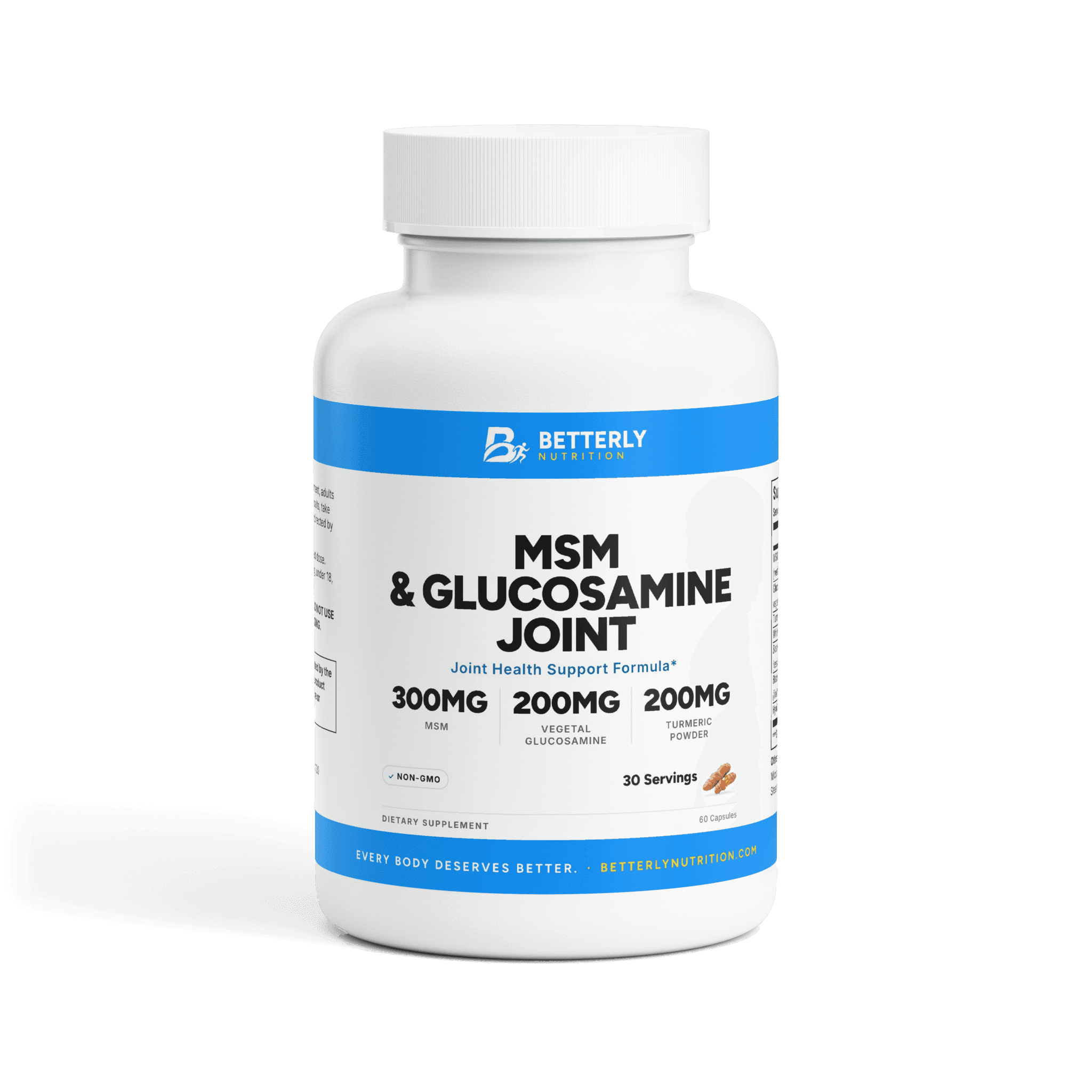
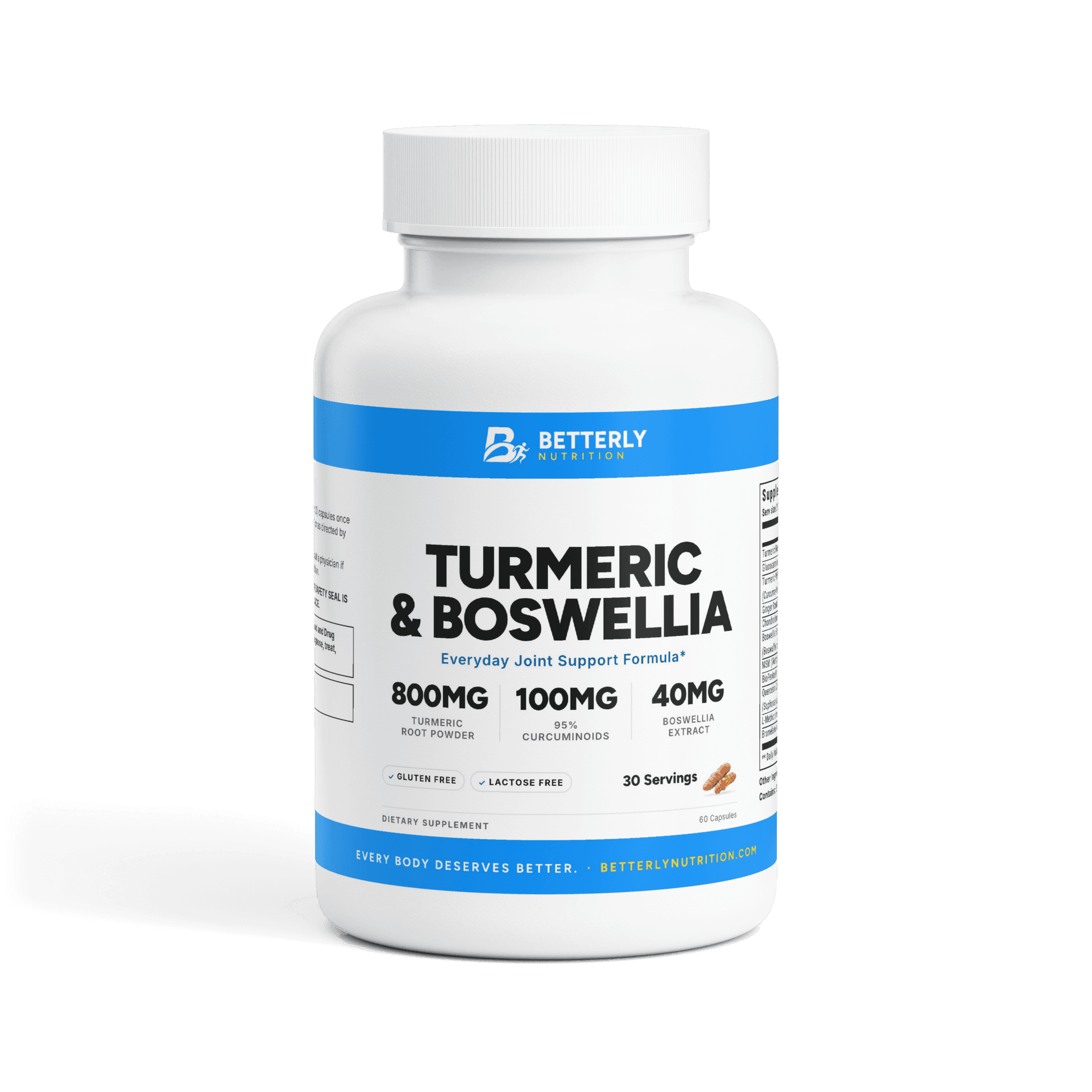
- Betterly's MSM & Glucosamine Joint Capsules list 300 mg of MSM per 2-capsule serving, and our Turmeric Curcumin & Boswellia Capsules list 10mg.
Full disclosure: two Betterly labels list MSM, and we earn money when you buy either one. Our MSM & Glucosamine Joint Capsules put MSM first on the panel, and our Turmeric Curcumin & Boswellia Capsules carry a trace of it. Every number we give for them comes from their printed Supplement Facts, and the evidence gaps below apply to our bottles too.
What is MSM, and where does it come from?
MSM is methylsulfonylmethane, a small organic compound made of two carbon atoms, six hydrogens, two oxygens and one sulfur atom.
The PubChem record for dimethyl sulfone, from the NIH's National Library of Medicine, lists MSM under that chemical name. It describes MSM as a normal breakdown product of DMSO (dimethyl sulfoxide) that's found in foods. It also notes MSM occurs in some plants and is marketed as a dietary supplement for joint health.
PubChem gives no amount per food, and neither does any federal page we checked, so there's no honest estimate of how much MSM you already eat.
MSM powder, crystals or capsules?
MSM is sold as capsules, tablets, loose powder and coarse crystals. The form changes how you take it, not the molecule.
- Capsules and tablets hold a fixed amount per serving, so there's nothing to measure.
- Powder and crystals list a serving size that you scoop out and mix into a drink.
- Blends tuck MSM into a longer formula. NCCIH notes MSM is sold either alone or combined with other ingredients such as glucosamine.
What are the benefits of an MSM supplement, going by the evidence?
MSM supplement benefits aren't established: NCCIH says research on MSM as a joint supplement is small, and no conclusions can be reached about whether it helps.
That verdict comes from NCCIH's page on DMSO and MSM, which weighs both compounds only in that joint context. The page is brief, and it was last updated in September 2017. We found no newer federal consumer page on MSM, so check the sources behind any long benefit list you read elsewhere.
You'll also see MSM pitched for workout recovery and in beauty blends, but no federal consumer page we checked addresses either use, so we leave those claims alone. Our guide to hair, skin and nail supplements doesn't cover MSM; it sticks to collagen, biotin, vitamin C, zinc and a few other nutrients.
How much sulfur does 300 mg of MSM actually give you?
About 34% of MSM's weight is sulfur, so 300 mg of MSM carries roughly 102 mg of sulfur.
Here's the arithmetic. PubChem lists MSM's molecular weight at 94.14, with one sulfur atom in the formula. Sulfur's atomic weight is about 32.06, and 32.06 divided by 94.14 is about 0.34. Per 2-capsule serving, that gives:
- MSM & Glucosamine Joint Capsules: 300 mg of MSM, or about 102 mg of sulfur.
- Turmeric Curcumin & Boswellia Capsules: 10mg of MSM, or about 3.4 mg of sulfur.
Those sulfur figures are our estimates. Neither label prints a sulfur number.
Is 102 mg of sulfur a meaningful amount? The label offers no yardstick. On the joint capsule's panel, the % Daily Value column shows three asterisks beside MSM, and its footnote marks that value "not established."
Is 300 mg of MSM a lot?
There's no federal daily amount for MSM, so 300 mg can't be rated high or low; it can only be set beside other labels and FDA's food-ingredient notice.
That notice is GRN No. 229 in FDA's GRAS notice inventory. GRAS, short for "generally recognized as safe," is a status that applies to food ingredients. The company that filed it described using MSM in meal replacements, smoothie-type drinks and thirst-quencher drinks at up to 4,000 mg per kilogram. For granola and energy bars, the figure was up to 30,000 mg per kilogram. FDA closed the notice on February 18, 2008, with a letter saying it had no questions.
By our math, those limits would allow up to about 960 mg in an 8-ounce drink (about 240 g), or about 1,200 mg in a 40 g bar. They're food-use ceilings, not a suggested intake, and they never override a supplement's directions. Our joint capsule's 300 mg is under what one such drink or bar could hold, but that size comparison tells you nothing about the safety of a daily MSM supplement.
| Option | MSM per serving | Also on the panel | Worth a look if you... |
|---|---|---|---|
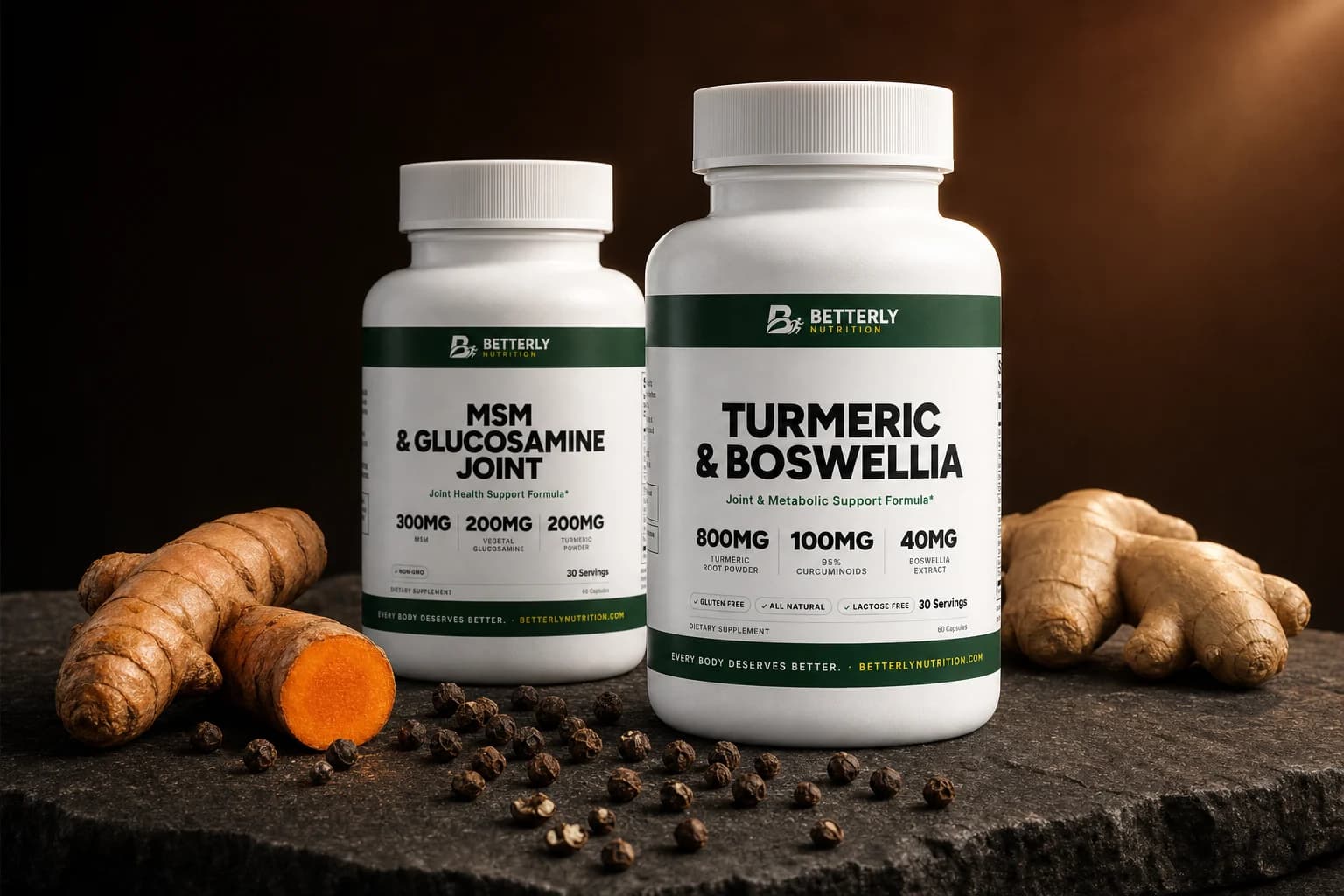
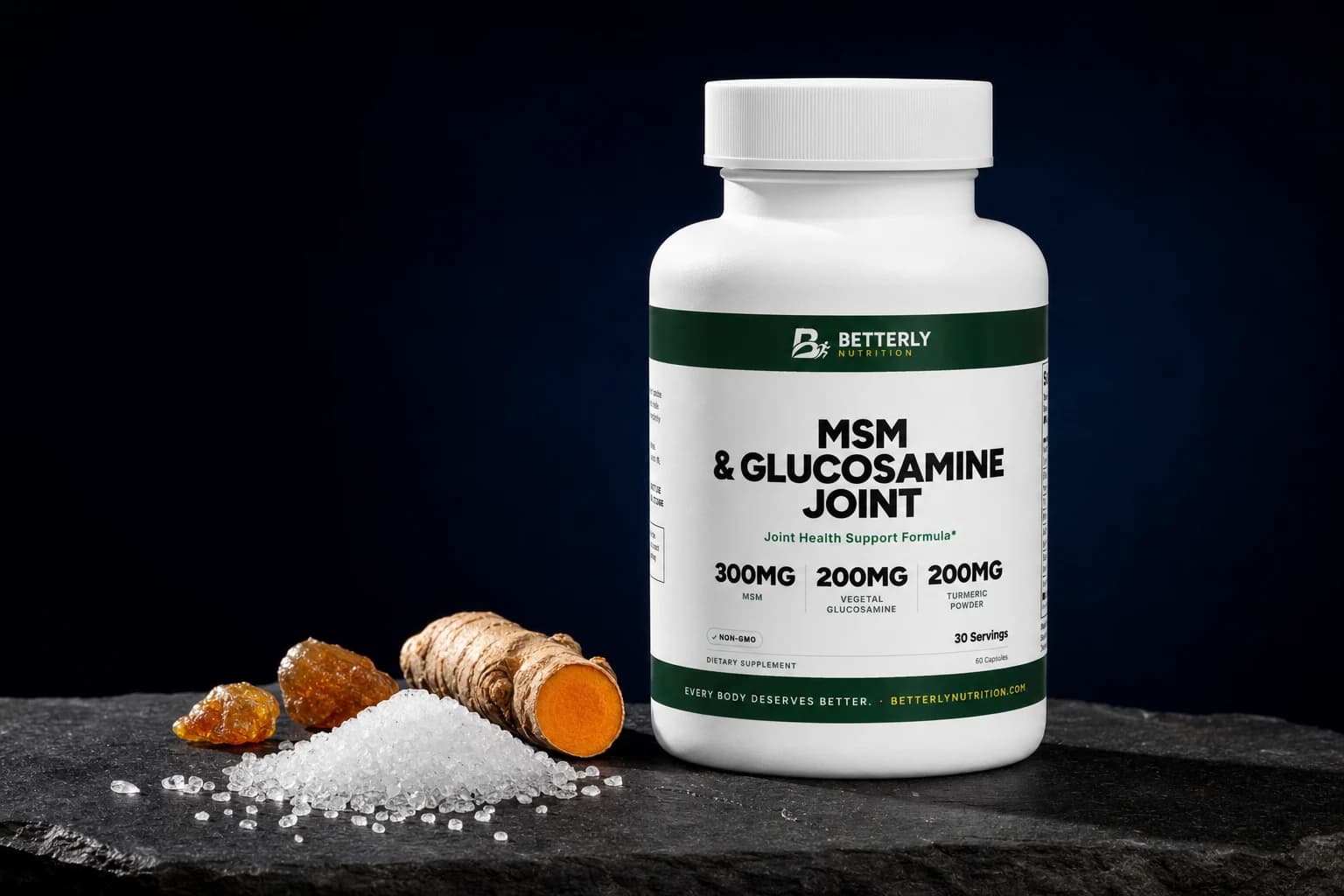
| MSM & Glucosamine Joint Capsules | 300 mg per 2 capsules | Glucosamine HCl, turmeric, white willow bark, boswellia | Want MSM as the lead line of a joint formula |
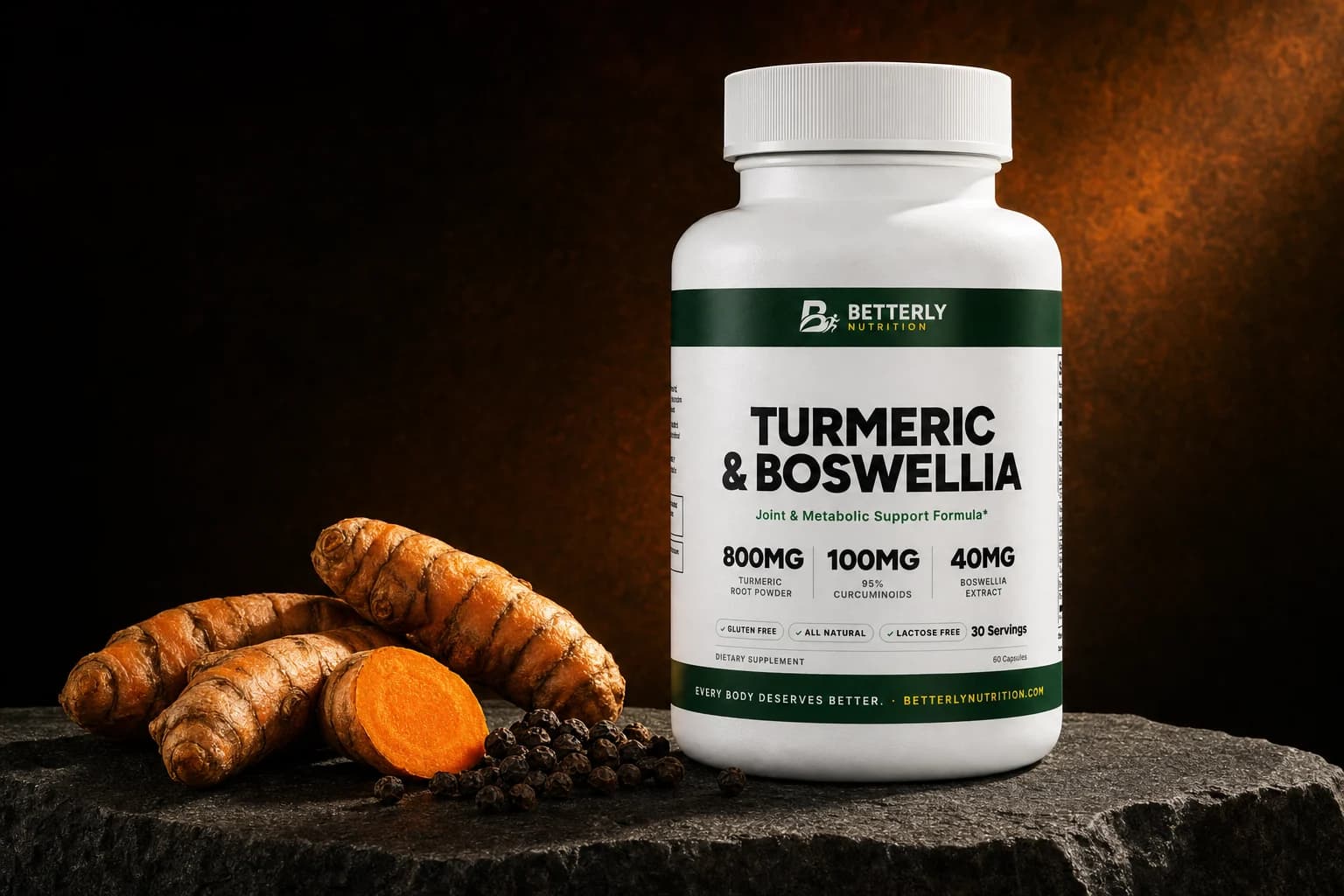
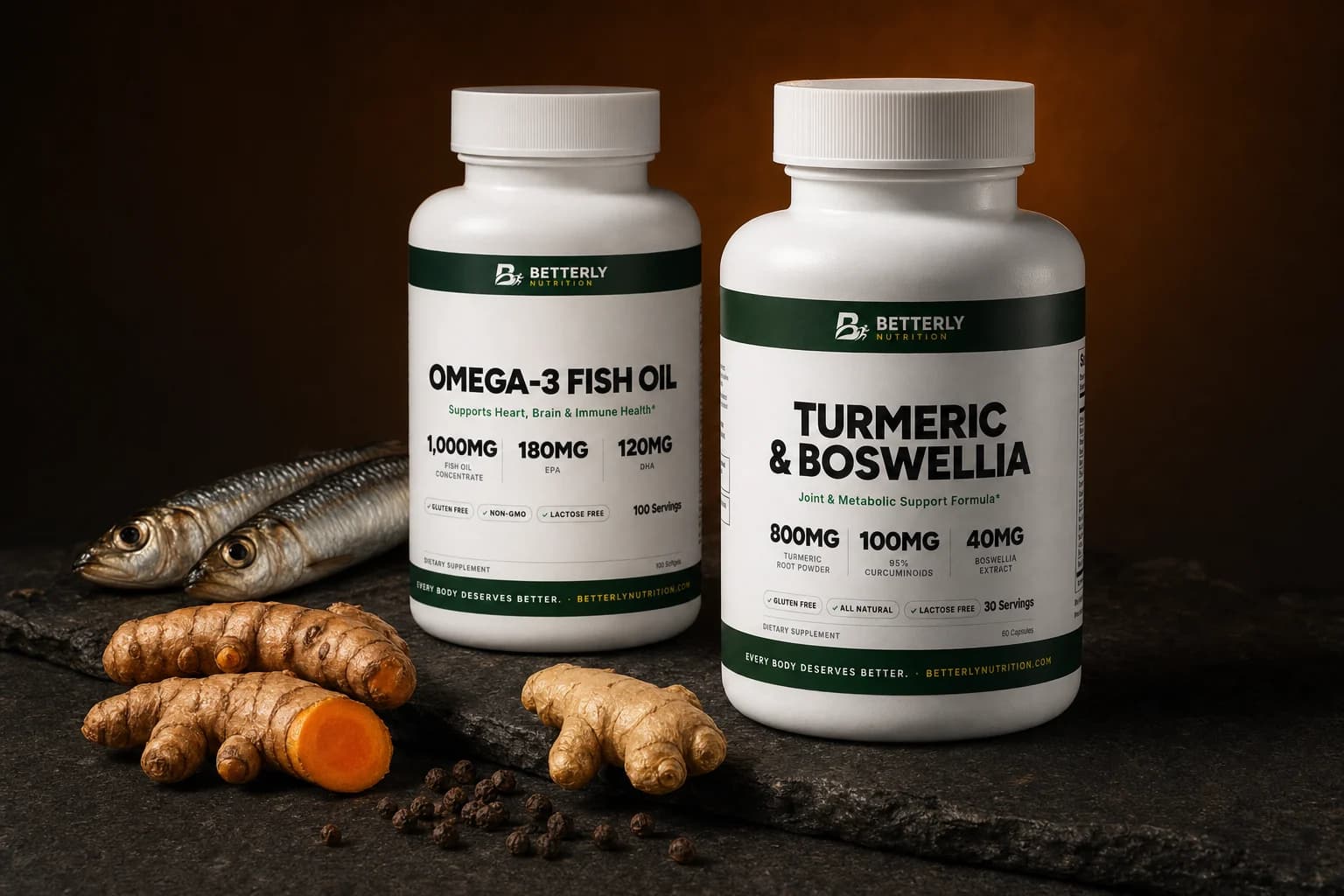
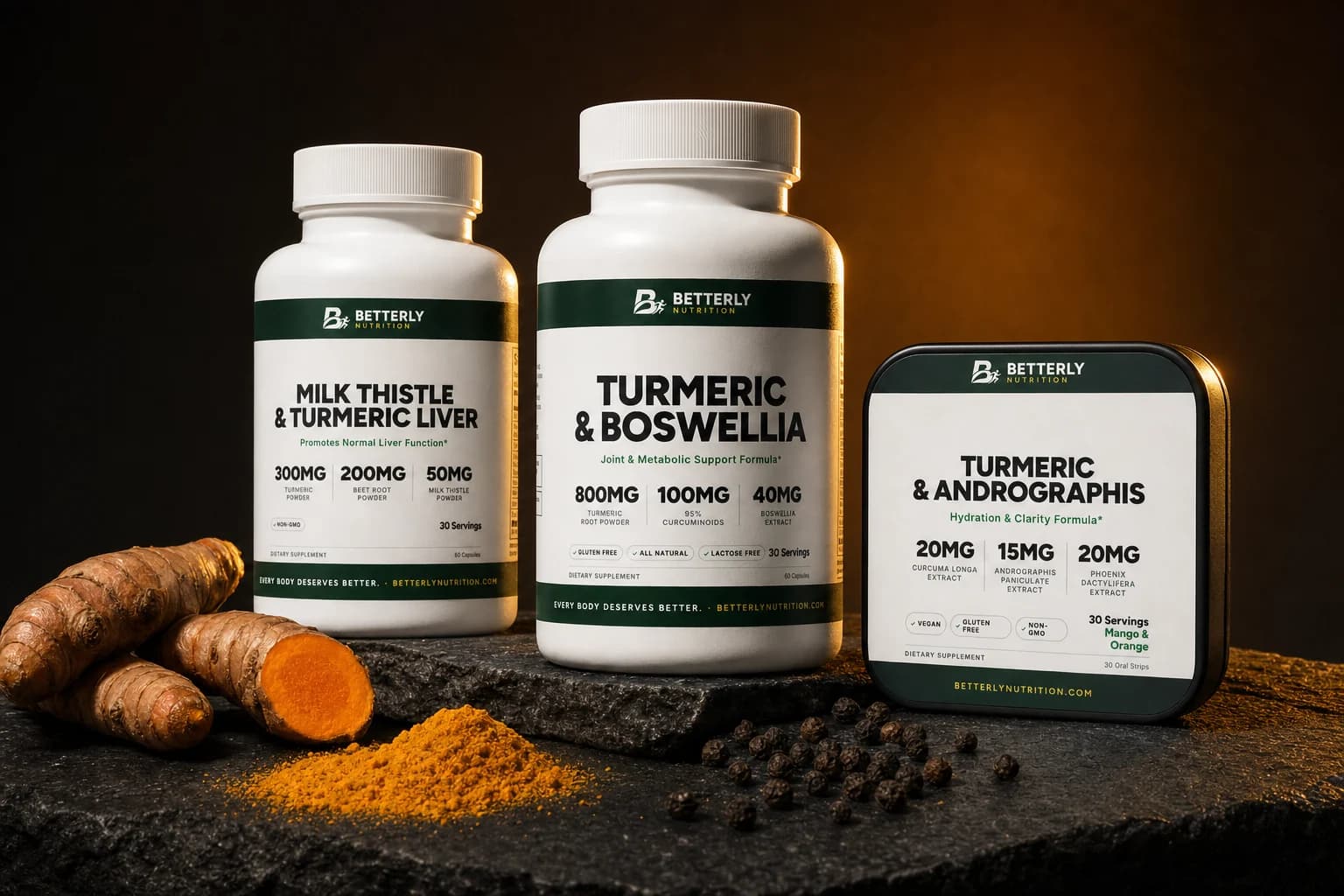
| Turmeric Curcumin & Boswellia Capsules | 10mg per 2 capsules | Turmeric, glucosamine sulfate, chondroitin, ginger | Mainly want turmeric |
| MSM-only powder or capsule | Varies by brand | Check its other ingredients | Want MSM without botanicals |
The takeaway: the letters "MSM" on a front label tell you almost nothing about the amount. Our two bottles differ 30-fold. A whole 30-serving bottle of the turmeric capsules holds 300mg of MSM, the same as one day's serving of the joint capsules.
From our shop: MSM & Glucosamine Joint Capsules — MSM leads the panel at 300 mg per 2-capsule serving, ahead of 200 mg of GlucosaGreen® vegetal glucosamine HCl, with 30 servings per bottle.
MSM vs DMSO vs glucosamine: how are they related?
MSM and DMSO are chemically related sulfur compounds, while glucosamine is a separate ingredient that can share a joint-formula label with MSM.
NCCIH says DMSO is applied to the skin, while MSM is the one sold as a dietary supplement. Their side-effect lists differ too. NCCIH ties a garlic-like taste, breath and body odor to DMSO, and that item isn't on its MSM list.
Glucosamine is unrelated to MSM chemically, yet the two can share a bottle, as they do in our joint capsule. Our comparison of glucosamine HCl and sulfate covers glucosamine's salt forms, its sourcing and what NCCIH says about glucosamine and warfarin.
Collagen, the other name people weigh against MSM, is a protein usually counted in grams, so the two don't swap one for one.
What are the side effects of MSM supplements?
NCCIH lists allergic reactions, digestive upsets and skin rashes as side effects of MSM, and it says MSM's safety is uncertain because little research has been done.
In NCCIH's own words: "The safety of DMSO and MSM is uncertain because little research has been done on this topic." A short list of side effects isn't a clean bill of health.
The NIH Office of Dietary Supplements (ODS) describes a broader pattern in its consumer guide to dietary supplement basics. People run the highest odds of side effects when they take large doses, swap a supplement in for a prescribed medicine, or combine many different supplements.
That last point fits MSM, which shares a capsule with 6 other ingredients in our joint formula and 10 in our turmeric one. A reaction after you start either may trace back to a different line.
If you think you've reacted to a supplement, stop and let your healthcare provider know. ODS notes your provider may report it to FDA, and you can file a report yourself.
How do you take MSM, according to the label?
Take MSM exactly as your product's label directs. For our MSM & Glucosamine Joint Capsules, that means 2 capsules daily with 6-8 oz (177-237ml) of water.
Word for word, the label says: "As a dietary supplement, adults take two (2) capsules daily. For best results, take with 6-8 oz (177-237ml) of water or as directed by healthcare professional." Nothing in it points to morning, evening or meals, so pair it with a glass of water you already drink every day. The Turmeric Curcumin & Boswellia Capsules differ: two capsules once a day, 20-30 minutes before a meal.
Four label habits help with any MSM product:
- Read the serving size. On both of our panels a serving is 2 capsules, so 300 mg is the amount in two capsules, not one.
- Measure powders. A heaped scoop of crystals isn't the serving the panel describes.
- Don't double up. Both of our labels say, "Do not exceed recommended dose." Doubling the joint capsules doubles every line, including the 150 mg of white willow bark extract.
- Spot overlap. Taking both of our bottles adds only 10mg of MSM but repeats glucosamine (in two different salt forms), turmeric, boswellia and a pepper extract, and neither label suggests pairing them.
When don't you need an MSM supplement?
You likely don't need an MSM supplement if you're counting on a promised result, because NCCIH says research on MSM for joints is too small to support any conclusion.
Other reasons to skip it or wait:
- If your joint formula already lists MSM, a second bottle would only repeat it.
- If sulfur itself is the goal, keep in mind that MSM has no Daily Value, so there's no known gap for a capsule to fill.
- If you steer clear of gelatin, our joint capsule is out, since its shell is gelatin. Its label prints no allergen statement, but it doesn't claim to be shellfish-free.
- If you avoid shellfish, pass on our turmeric capsule, whose label declares crab, lobster and crawfish. Avoid both, and our shelf has no MSM option for you.
- If you want MSM on its own, look elsewhere. Our joint capsule pairs its 300 mg of MSM with six other ingredients, and we don't sell an MSM-only product.
Both bottles are listed in our Targeted Support collection alongside our other targeted formulas, and each listing shows its full Supplement Facts.
From our shop: Turmeric Curcumin & Boswellia Capsules — a turmeric-first formula with 10mg of MSM as a minor line beside 800mg of turmeric root powder per 2-capsule serving, and a shellfish allergy warning on the label.
Who should check with a healthcare provider before taking MSM?
Before trying MSM, run it past a doctor or pharmacist if you're under 18, expecting, breastfeeding, taking prescriptions, facing an operation, or have a medical condition.
The caution printed on both of our MSM bottles covers most of that: "Consult a physician if pregnant, nursing, under 18, or have a medical condition." ODS fills in the rest:
- Pregnancy and nursing. ODS urges care with supplements other than a basic prenatal during pregnancy and breastfeeding. MSM gives you even less to go on, since NCCIH calls its safety uncertain.
- Children. ODS advises care before giving a child any supplement their provider hasn't recommended.
- Medicines. Per ODS, some supplements raise the odds of bleeding and others clash with medicines. On a blood thinner? Have your prescriber review the joint capsule's full panel first, including its 150 mg of white willow bark extract.
- Surgery. ODS explains that certain supplements can shift how anesthesia works on you. List every bottle for the people handling your operation, both MSM products included if you use them.
- Allergies. NCCIH lists allergic reactions among MSM's side effects. Anyone allergic to shellfish should skip our turmeric capsule, and our turmeric safety checklist covers who else should pass on it.
Bring the whole bottle to that talk, not just the word "MSM." Your provider needs to see the white willow bark, boswellia, turmeric and black pepper extract on the joint capsule's panel.
FAQ: MSM supplements
Is it safe to take MSM every day?
Nobody can say for sure, because MSM's everyday safety hasn't been studied much and NCCIH calls it uncertain. Our joint capsule's label is written for daily use, 2 capsules a day, and adds, "Do not exceed recommended dose." Staying within those directions is as far as the evidence lets us go. If you plan to take MSM for months, or you also take other supplements or medicines, run the plan past a healthcare provider.
Is MSM safe during pregnancy or while breastfeeding?
MSM hasn't been researched enough to call it safe during pregnancy or breastfeeding, so ask your provider before taking it. Both of our MSM labels point pregnant and nursing adults to a physician. ODS adds that pregnancy and nursing are stages where many supplements lack solid safety data.
Should you take MSM in the morning or at night?
Either works, because neither of our MSM labels mentions morning or night, so the best time is the one you won't forget. The MSM & Glucosamine Joint Capsules call for 2 capsules daily with 6-8 oz of water. The Turmeric Curcumin & Boswellia Capsules call for 2 capsules once a day, 20-30 minutes before a meal. If another MSM product you own names a time, follow its label.
Does MSM make you smell like garlic or sulfur?
Body odor isn't on NCCIH's list of MSM side effects. NCCIH links a garlic-like taste, breath and body odor to DMSO, MSM's chemical relative, which is applied to the skin. The side effects it lists for MSM are allergic reactions, digestive upsets and skin rashes. If you notice anything unexpected after starting an MSM product, stop and tell your healthcare provider.
Can you take MSM and glucosamine together?
Yes, MSM and glucosamine can share a capsule, and NCCIH notes MSM is sold either alone or combined with ingredients such as glucosamine. Each 2-capsule serving of our MSM & Glucosamine Joint Capsules lists 300 mg of MSM beside 200 mg of GlucosaGreen® vegetal glucosamine HCl. Adding a separate glucosamine product would repeat an ingredient, so check your other labels first. If you take a blood thinner, ask your prescriber before starting either.
Sources
- NCCIH page on dimethyl sulfoxide (DMSO) and methylsulfonylmethane (MSM), National Center for Complementary and Integrative Health
- GRN No. 229: Methylsulfonylmethane, FDA GRAS Notice Inventory
- Dimethyl sulfone (CID 6213), PubChem, National Library of Medicine
- Dietary Supplements: What You Need to Know, NIH Office of Dietary Supplements
If this left you looking for somewhere to start, read MSM capsules with 300 mg per serving — its amounts per serving are listed on the page. For the practical questions this raises, how dosing, sourcing and subscriptions work is answered in one place.