On this page
- Key takeaways
- What is ox bile, and what is it made of?
- What does bile do in your body?
- What are the real ox bile benefits, and where does the evidence stop?
- Is ox bile a bile salt, or the same as bile salts?
- What does "standardized to 40% cholic acid" mean?
- What else is in an ox bile and artichoke capsule?
- When should you take ox bile, going by the label?
- Who doesn't need an ox bile supplement?
- Who should check with a healthcare provider first?
- FAQ: Ox bile
- Sources
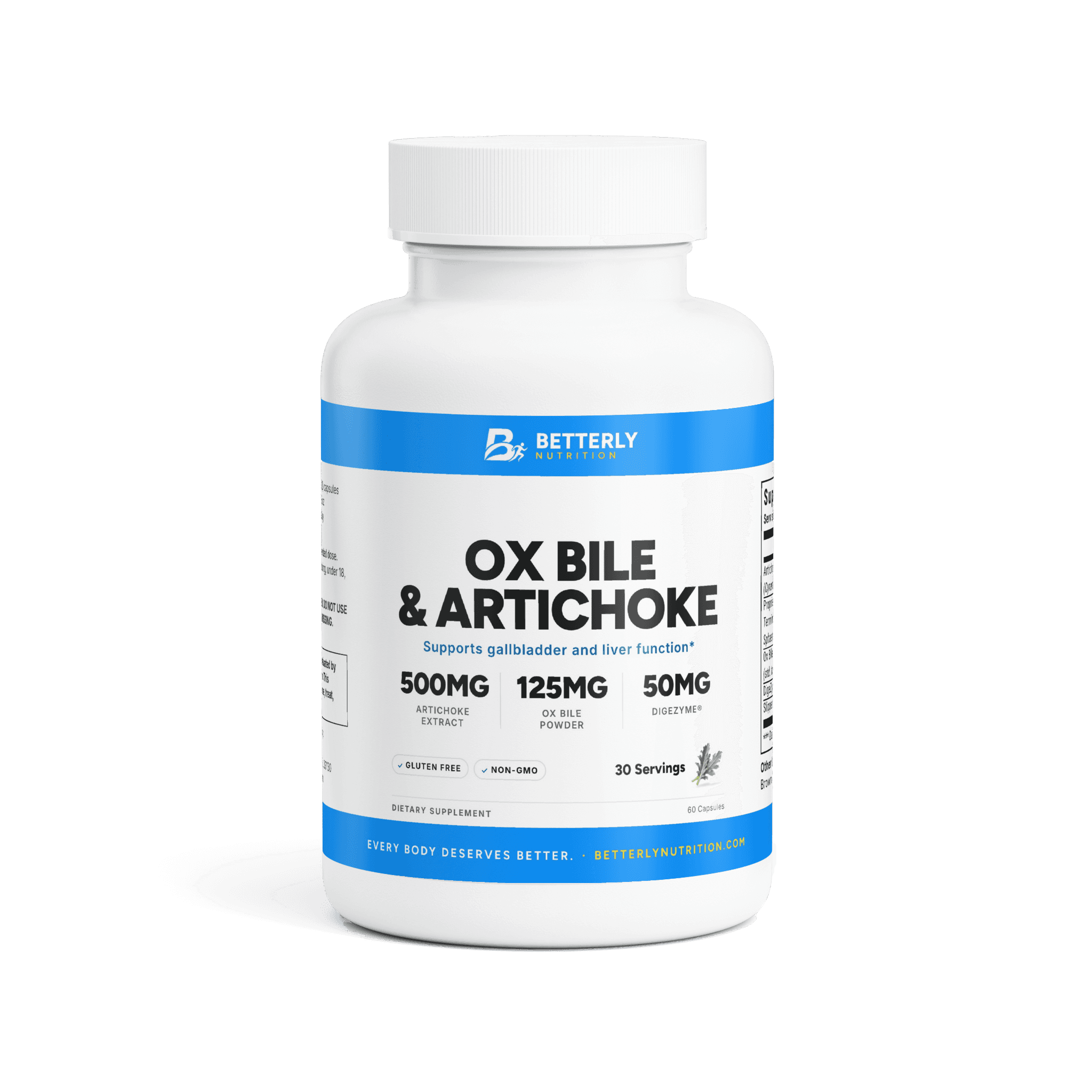
The short answer: Ox bile benefits trace back to one job: bile helps your body break down the fat in food. MedlinePlus lists bile acids, also called bile salts, among bile's main parts. An ox bile supplement is dried bile from cattle. Ours has 125 mg per 2-capsule serving, standardized to 40% cholic acid. Your liver already makes bile, and we found no federal source saying healthy adults need more.
Key takeaways
- Bile is a digestive fluid your liver makes and your gallbladder stores, and it helps break fats into fatty acids.
- Ox bile is dried bile from cattle, so it contains bile salts without being only bile salts.
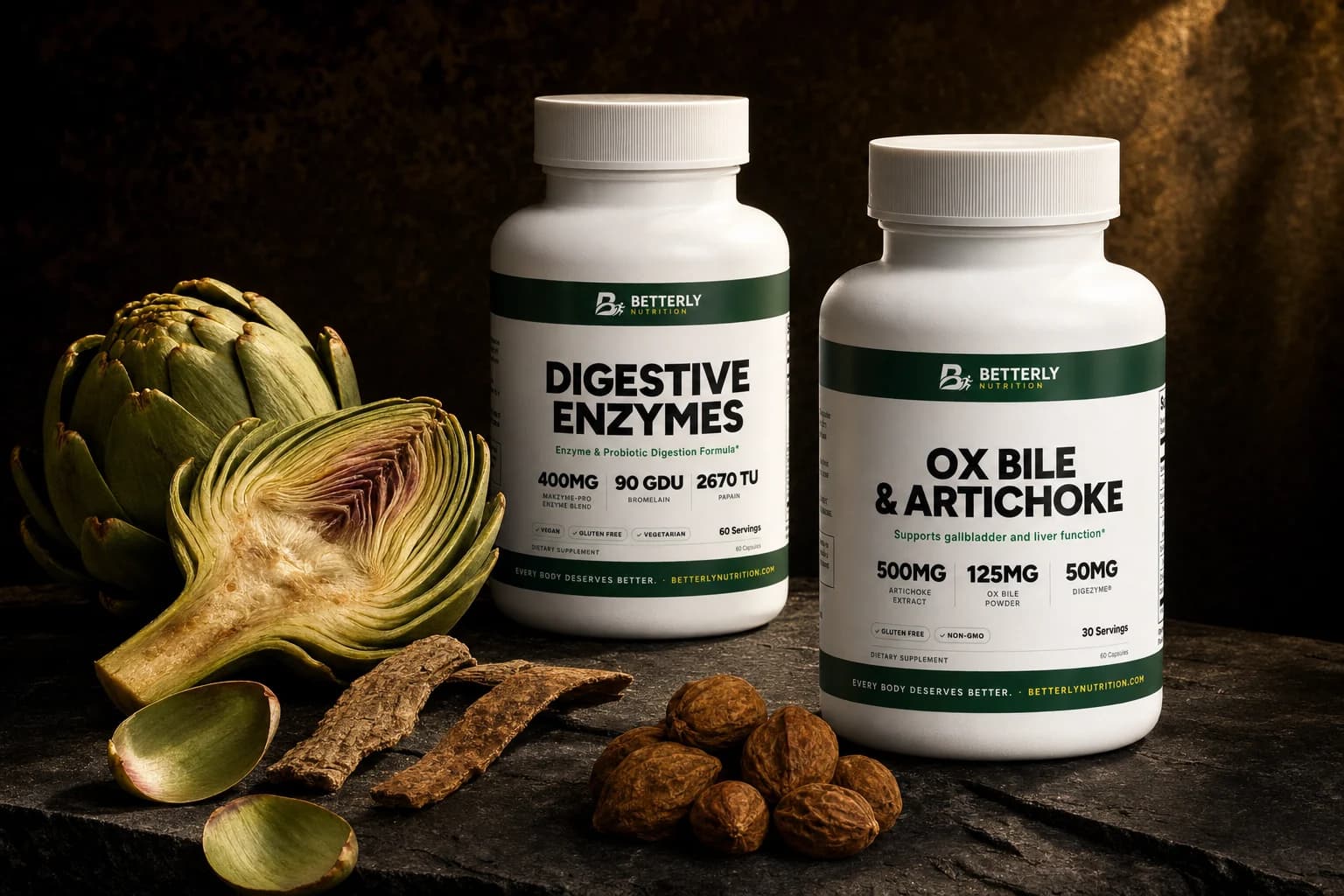
- Betterly's Ox Bile & Artichoke Capsules put 50 mg of cholic acid (inside 125 mg of ox bile powder) and 500 mg of artichoke leaf extract in every 2-capsule serving.
- Our label asks for 2 capsules a day with 6-8 oz of water and names no meal or time of day.
- Neither the bile nor the gelatin shell is plant-based, so the product doesn't fit a vegan or vegetarian diet.
Betterly sells the ox bile capsule you'll see throughout this guide. Its name puts ox bile first, though bile ranks third of the five ingredients its panel lists, so we read every row and say plainly where one falls short.
What is ox bile, and what is it made of?
Ox bile is the digestive fluid of cattle, dried to a powder and packed into capsules so a supplement can supply bile acids.
You may also see it called ox gall or bovine bile. On a panel it usually shows up as "ox bile powder" or "ox bile extract," often followed by a percentage in parentheses. That percentage matters, and we'll get to it.
So what's in bile itself? The MedlinePlus Medical Encyclopedia entry on bile says it's mostly cholesterol, plus bile acids (which it notes are also called bile salts) and bilirubin. Water, body salts such as sodium and potassium, and copper and other metals round out the mix.
MedlinePlus is describing human bile, not cattle bile, but it hands you the right vocabulary. When a label says ox bile, picture a dried digestive fluid with several parts, not one pure compound.
What does bile do in your body?
Bile helps you digest fat. MedlinePlus says it breaks fats down into fatty acids, which your digestive tract can then take into the body.
NIDDK, part of the National Institutes of Health, maps the route in its plain-language guide to how your digestive system works. Your liver makes bile. Small tubes called bile ducts carry it to your gallbladder for storage, or straight to your small intestine for use. Between meals, the gallbladder holds on to it. When you eat, it squeezes bile into the small intestine, where it mixes with juices from the pancreas and the intestine itself. NIDDK adds that bile helps digest some vitamins, too.
The National Library of Medicine's MeSH entry for cholic acids, the bile acids named on our label, gives a handy picture. It says they act as detergents that solubilize fats, which means they help fat mix into the watery contents of your gut. Think of dish soap lifting grease off a pan. The entry adds that the small intestine reabsorbs them.
What are the real ox bile benefits, and where does the evidence stop?
The solid part of the ox bile benefits story is what bile does naturally: it helps digest fat. No federal page we read says a supplement adds to that for healthy adults.
Bile's role in fat digestion is basic physiology, described by MedlinePlus, NIDDK and the National Library of Medicine. The open questions are about the supplement:
- Our research for this guide turned up no government fact sheet devoted to ox bile supplements.
- No federal source we read compares 125 mg of ox bile with the amount of bile your own body makes.
- Effectiveness isn't pre-checked. The NIH Office of Dietary Supplements (ODS) explains in Dietary Supplements: What You Need to Know that the FDA doesn't rule on whether a product works before it reaches shelves.
The front of our bottle says "Supports gallbladder and liver function*." Wording like that is a structure/function statement. It points to a normal body job and never says what you'll notice, and its asterisk pairs it with the FDA disclaimer printed elsewhere on the label.
A lot of what ranks for this search ties ox bile to specific medical situations. Those belong in a conversation with your doctor, so we've left them out.
Is ox bile a bile salt, or the same as bile salts?
Ox bile isn't the same thing as bile salts. Ox bile is the whole dried fluid, and bile salts are one family of compounds inside it.
Go back to the MedlinePlus list, where bile acids share space with cholesterol, bilirubin, water and minerals. A scoop of ox bile powder carries bile salts along with everything else bile holds. That's why a careful label adds a standardization: it tells you how much of the powder is a named bile acid.
If a product says only "bile salts," check its panel for the source animal and an amount per serving. Cholic acid, the compound on our label, is one specific bile acid within that family.
What does "standardized to 40% cholic acid" mean?
Standardized to 40% cholic acid means cholic acid makes up 40% of the ox bile powder by weight, so 125 mg of powder holds 50 mg of cholic acid.
Here's the math for Betterly's capsule, all taken from its panel:
- Per 2-capsule serving: 125 mg of ox bile powder, 50 mg of it cholic acid.
- Per capsule: 62.5 mg of powder and 25 mg of cholic acid.
- Per 60-capsule bottle: 3,750 mg (3.75 g) of ox bile powder, with 1,500 mg of cholic acid.
The panel is silent on the remaining 75 mg of powder in each serving.
A percentage is what makes two powders comparable. If two labels both say 125 mg of ox bile and neither gives one, you can't tell which carries more cholic acid.
How to read an ox bile line on any label:
- Find the serving size first. Ours is 2 capsules, so every amount covers both.
- Check that ox bile has its own row with its own mg, not a spot inside a blend.
- Look for a standardization and the compound it names.
- Read the "other ingredients" line for the capsule material.
What else is in an ox bile and artichoke capsule?
Artichoke leaf extract, not ox bile, is the largest listed ingredient in Betterly's Ox Bile & Artichoke Capsules: 500 mg of the 1,015 mg the panel lists per 2-capsule serving.
| Ingredient | Per 2-capsule serving | Share of listed weight | Detail printed |
|---|---|---|---|
| Artichoke extract (Cynara scolymus, leaf) | 500 mg | About 49% | Leaf; no standardization |
| Proprietary blend (Terminalia chebula fruit, Sphaeranthus indicus flower) | 300 mg | About 30% | One total for two herbs |
| Ox bile powder | 125 mg | About 12% | Std. to 40% cholic acid |
| DigeZyme® | 50 mg | About 5% | Brand name only |
| Slippery elm bark extract | 40 mg | About 4% | Bark; no extract ratio |
Ox bile leads the product's name and is the only row with a standardization, yet it's about one-eighth of the panel's listed weight. Roughly four-fifths of that listed weight is artichoke leaf and the herbal blend. The capsule shell and fillers aren't weighed on the panel at all.
A few notes on the other rows:
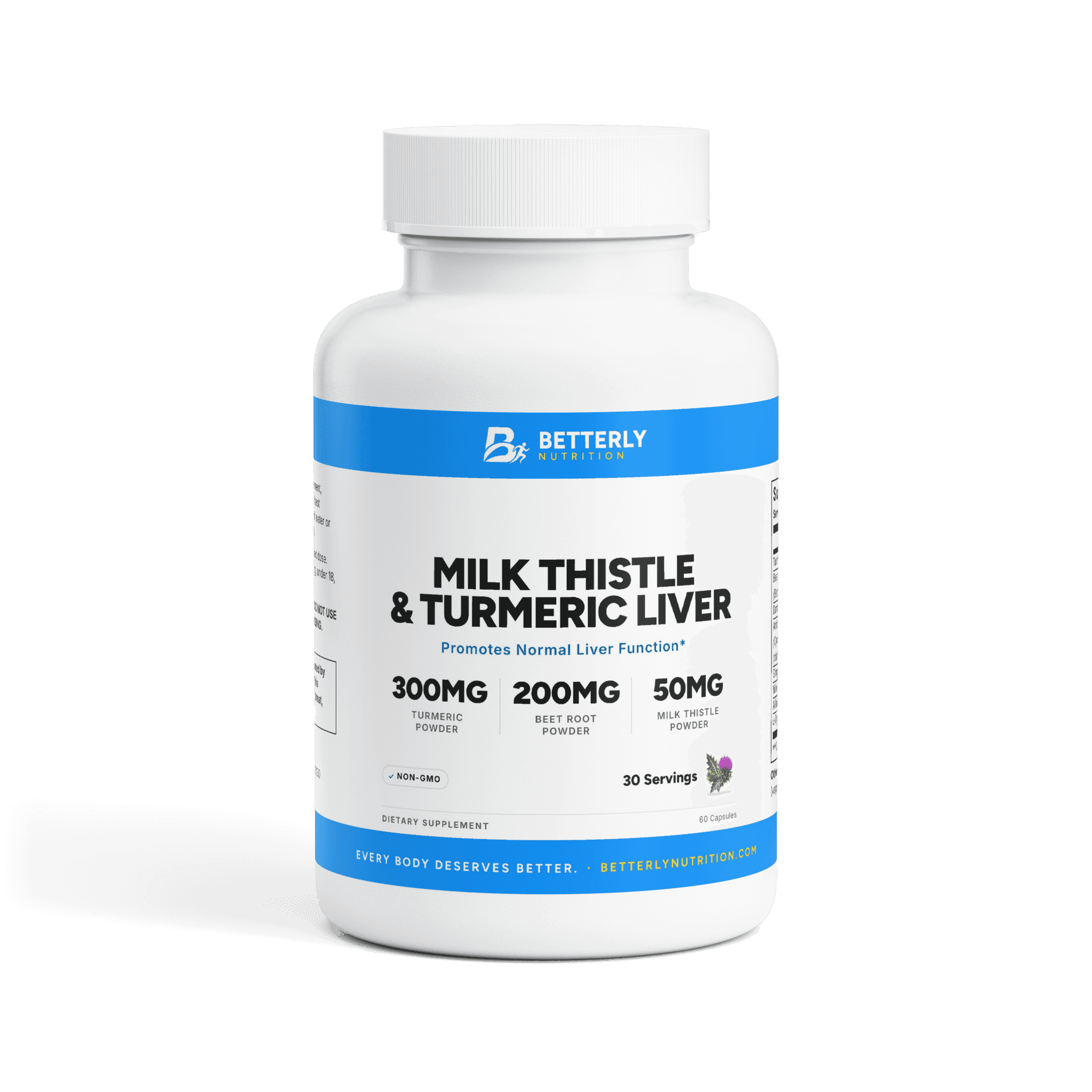
- Our Milk Thistle & Turmeric Liver Capsules list 50 mg of artichoke extract (whole herb) standardized to 5% cynarin. The ox bile capsule lists 500 mg of leaf extract with no percentage, so the plant part differs and you can't compare cynarin between the two. Our guide to artichoke leaf extract covers the plant itself.
- A proprietary blend gives one total for several ingredients. Read how to size up a proprietary blend before you decide whether that trade-off bothers you.
- The DigeZyme® row prints a trademark and a 50 mg weight, with no components or activity units listed.
- Gelatin forms the capsule, with brown rice flour and magnesium stearate listed too. The label carries gluten-free and non-GMO claims.
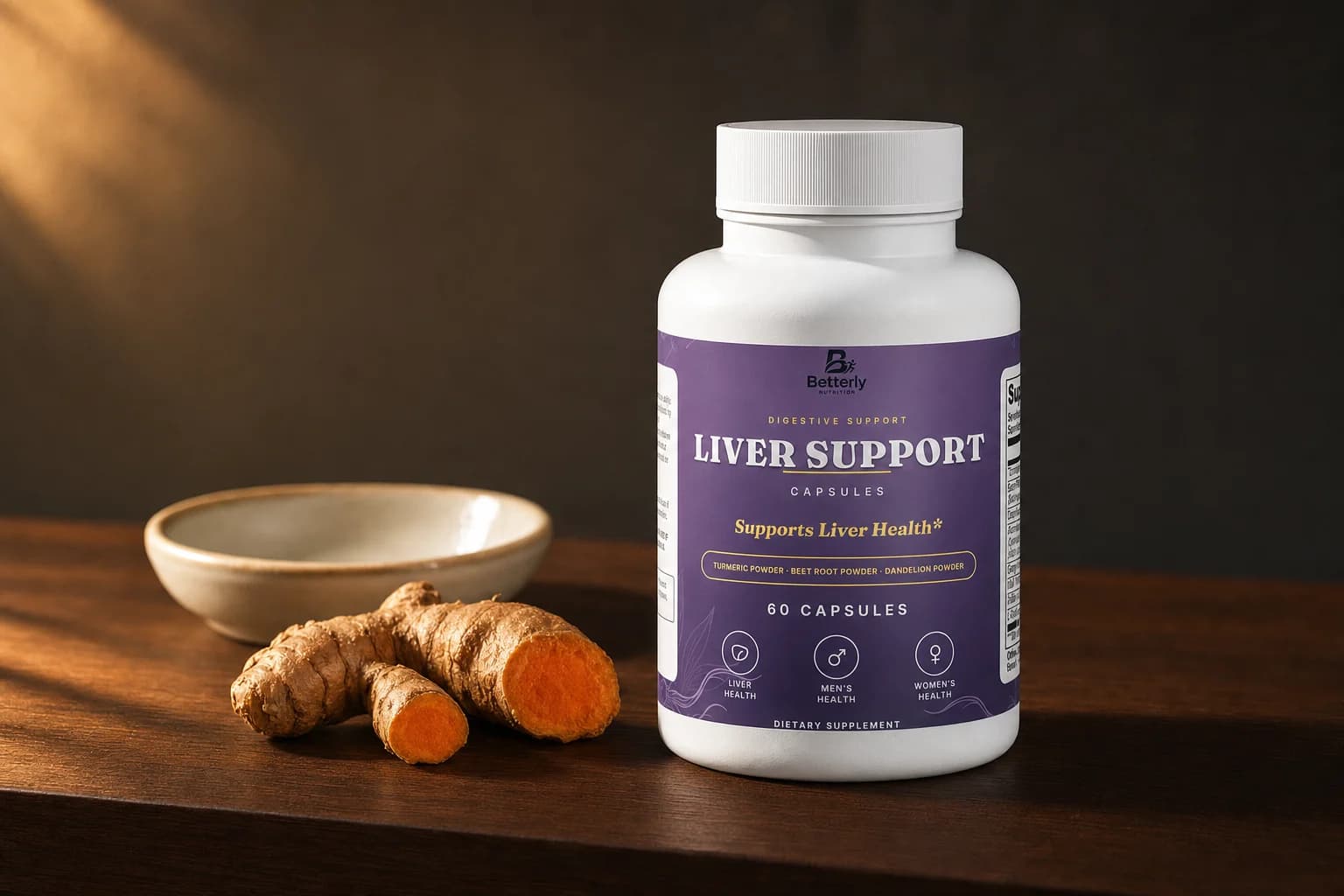
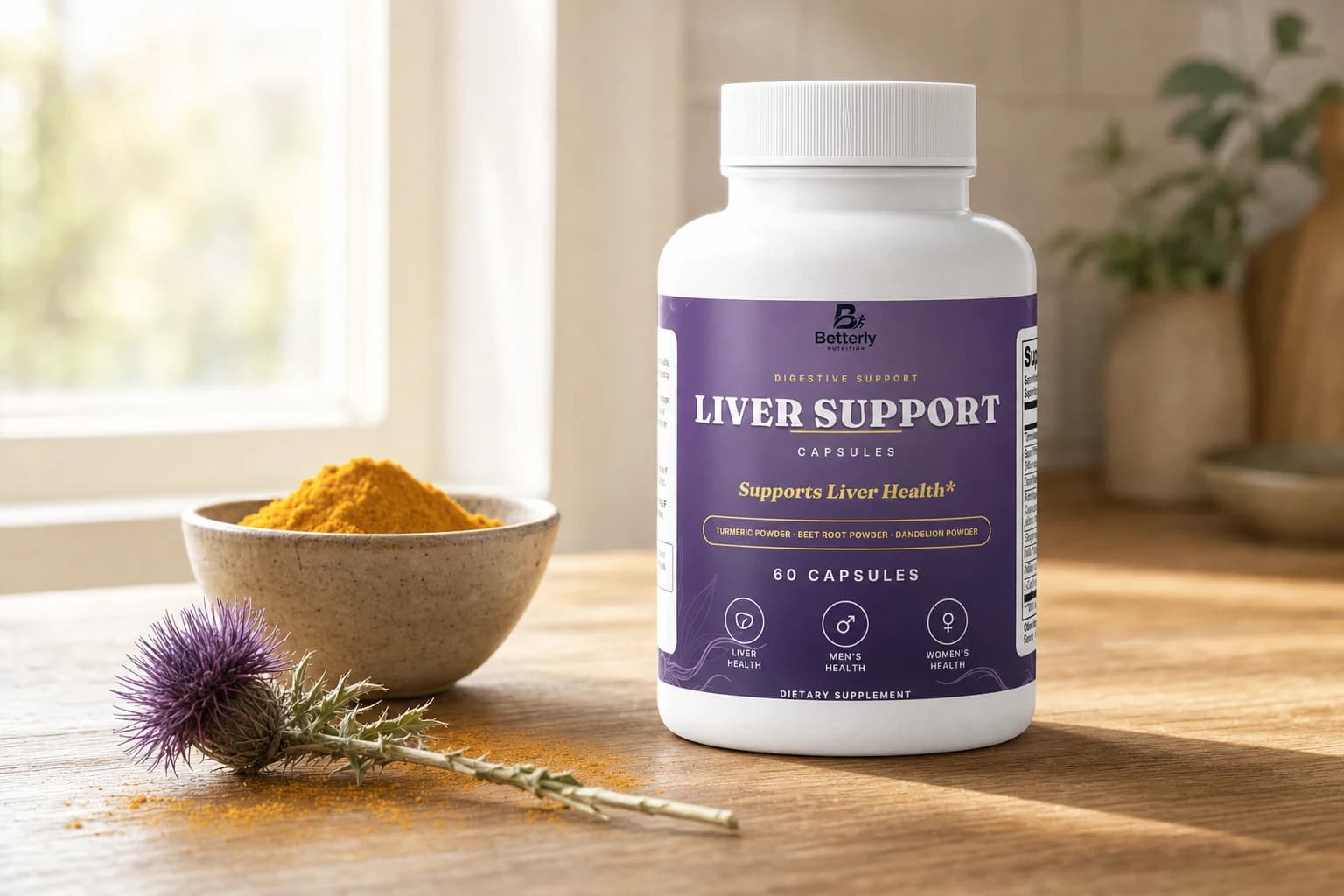
From our shop: Ox Bile & Artichoke Capsules — each 2-capsule serving delivers 50 mg of cholic acid from standardized ox bile, alongside 500 mg of artichoke leaf extract, in a 60-capsule bottle.
When should you take ox bile, going by the label?
Betterly's Ox Bile & Artichoke Capsules label gives one daily amount: 2 capsules, taken with 6-8 oz of water. It names no meal, no morning or evening, and no split.
Word for word, the suggested use reads: "Adults take two (2) capsules daily. For best results, take with 6-8 oz (177-237ml) of water or as directed by healthcare professional." The caution adds: "Do not exceed recommended dose."
You'll find plenty of advice online to take ox bile with your fattiest meal. That idea grows out of bile's job, but our label doesn't say it, and we don't add directions a label doesn't give. If meal timing matters to you, ask your pharmacist, who can also check it against anything else you take.
Here's how three of our digestion-shelf labels compare on directions:
| Product | Suggested use | Meal timing on the label |
|---|---|---|
| Ox Bile & Artichoke Capsules | 2 capsules daily with 6-8 oz of water | None given |
| Digestive Enzyme & Probiotic Capsules | 1 capsule twice a day | 20-30 minutes before a meal |
| Milk Thistle & Turmeric Liver Capsules | 2 capsules daily with 6-8 oz of water | None given |
The ox bile and liver capsules leave timing open. If you'd like directions pinned to mealtimes, the Digestive Enzyme & Probiotic Capsules label is the one of the three that prints them.
Who doesn't need an ox bile supplement?
Ox bile isn't an essential nutrient, because your liver makes bile on its own and your gallbladder releases it when you eat.
That's the everyday system NIDDK describes, so a healthy adult has no built-in reason to buy bile. Skip ox bile, or look at something else, if one of these fits:
- You eat vegan or vegetarian. Look for a plant-based digestion formula; this one pairs cattle bile with a gelatin shell.
- You want each ingredient's own amount. The 300 mg blend hides the split between its two herbs, and the 50 mg DigeZyme® row lists no components or activity units.
- You already take a liver formula. Our liver capsule has artichoke extract too, so add the rows up across bottles before stacking. Our honest look at liver support supplements covers what those formulas can and can't say.
- You're after a specific result. A structure/function statement isn't a promise, and the FDA doesn't check effectiveness before a supplement is sold.
- A medical situation is the reason you're looking. That's a question for your doctor, not for a label.
Still weighing digestion products in general? Start with how enzymes and probiotics differ, then browse the digestion shelf with every product's amounts per serving one click away.
From our shop: Digestive Enzyme & Probiotic Capsules — its panel names six enzymes, fungal lipase among them, in one 2500 HUT/400mg blend per 1 Veggie Capsule serving, and the label carries vegan and gluten-free claims.
Who should check with a healthcare provider first?
Clear ox bile with a healthcare provider first if you're pregnant or nursing, under 18, on any prescription, living with a medical condition, or facing an upcoming operation.
"Consult a physician if pregnant, nursing, under 18, or have a medical condition." That line, after "Do not exceed recommended dose," is the whole caution on our bottle. It's silent on prescriptions and surgery. ODS fills both gaps. It says supplements can interact with some medicines, and that a few can affect how anesthesia works on you if you take them in the run-up to an operation.
If you manage any condition of the liver, gallbladder or digestive tract, your own doctor should weigh in before you add bile from any source.
A simple habit helps here: write down each product you take and its dose, and bring that list to appointments. Anything that feels off after starting a new supplement is worth reporting to your provider, too.
FAQ: Ox bile
How much ox bile should you take per day?
Take no more ox bile than your product's label suggests. For Betterly's Ox Bile & Artichoke Capsules, that's 2 capsules daily, which supplies 125 mg of ox bile powder and 50 mg of cholic acid. We didn't come across any federal daily amount for ox bile, so the label's directions are your ceiling. Only a clinician familiar with your health should suggest a different amount.
Are bile acids and bile salts the same?
In everyday use, yes: bile acids and bile salts are two names for the same group of compounds. The MedlinePlus entry on bile lists bile acids and notes they're also called bile salts. MeSH, the National Library of Medicine's subject-heading list, adds that in people, cholic acids are usually conjugated with glycine or taurine, meaning each one is chemically joined to one of those two compounds. On our label, the named bile acid is cholic acid, at 50 mg per 2-capsule serving.
Should you tell your pharmacist you take ox bile?
Yes, tell your pharmacist about ox bile, the same way you'd mention any supplement. The NIH Office of Dietary Supplements asks you to tell every health care provider, pharmacists included, about the supplements you take, and it notes that some can interact with medicines. A pharmacist can check every row of the panel against your prescriptions, not only the bile. For reactions people describe, see our rundown of ox bile side effects.
How many days does a bottle of ox bile capsules last?
One bottle of Betterly's Ox Bile & Artichoke Capsules gives you 30 days at the label's pace. There are 60 capsules inside and the daily serving is 2, so you get 30 servings. Over a full bottle, you'd take 3,750 mg of ox bile powder, 1,500 mg of it cholic acid.
Can you buy ox bile on its own?
Yes, ox bile is also sold as a single-ingredient supplement, not only in combination formulas like ours. In our capsule, it's one of five rows and about one-eighth of the listed weight. If you want ox bile alone, look for a panel with one row, a clear mg amount per serving and a standardization percentage, then compare cholic acid per serving.
Sources
- Bile (MedlinePlus Medical Encyclopedia)
- Your Digestive System & How It Works (NIDDK)
- Cholic Acids: MeSH (National Library of Medicine)
- Dietary Supplements: What You Need to Know, Fact Sheet for Consumers (NIH Office of Dietary Supplements)
If this left you looking for somewhere to start, read ox bile and artichoke capsules — its amounts per serving are listed on the page. For the practical questions this raises, how dosing, sourcing and subscriptions work is answered in one place.