On this page
- Key takeaways
- What side effects do fiber capsules usually cause?
- Which psyllium fiber capsule side effects mean you should stop?
- What's in a fiber capsule besides fiber?
- Is cape aloe a laxative?
- What side effects are linked to aloe ferox?
- How much fiber do you actually get from a 2-capsule serving?
- How should you take Psyllium Fiber & Acai Capsules?
- When don't you need a fiber capsule at all?
- Who should check with a healthcare provider first?
- FAQ: fiber capsules side effects
- Sources
The short answer: The usual fiber capsules side effects are gas, bloating and abdominal cramps, which MedlinePlus links to a sudden rise in fiber. The part many reviews skip is what else a "fiber" capsule holds. Ours, Psyllium Fiber & Acai Capsules, lists aloe ferox powder at 18% aloin, an ingredient type FDA files under stimulant laxatives, plus black walnut hull, a tree nut, inside one 1,532 mg blend.
Key takeaways
- MedlinePlus says a quick jump in fiber can bring gas, bloating and abdominal cramps, and that the trouble often fades as your gut bacteria adjust.
- Our Psyllium Fiber & Acai Capsules name 11 ingredients inside one 1,532 mg proprietary blend per 2-capsule serving, with no amount for any of them.
- The aloe ferox powder on that panel reads 18% aloin, and FDA's over-the-counter drug rules list aloe and aloin under stimulant laxatives, not fiber.
- The same label declares tree nuts (black walnut hull), so it's a skip for anyone who avoids them.
Full disclosure: Betterly sells the capsule this post picks apart, and a psyllium powder that competes with it. Where our own label comes up short, we say so in plain words.
What side effects do fiber capsules usually cause?
Fiber capsules usually cause gas, bloating and abdominal cramps, which MedlinePlus ties to taking in lots of fiber too quickly.
The MedlinePlus page on fiber says the trouble often settles as your gut's own bacteria adapt, and that raising fiber slowly can help with gas or diarrhea.
Those effects come from the fiber itself, so capsules, powders and high-fiber meals share them. For psyllium by format, our comparison of psyllium husk capsules vs powder covers gas.
Most fiber supplement side effects land in one of three buckets:
- The fiber itself, which brings gas, bloating and cramps while your gut adjusts.
- The way you take it, since psyllium swells with liquid and the glass of water matters.
- Everything else on the panel, where each extra botanical brings its own cautions.
Which psyllium fiber capsule side effects mean you should stop?
Stop taking psyllium fiber capsules and call a doctor right away for trouble breathing, trouble swallowing, stomach pain, rash, itching, nausea or vomiting, the symptoms MedlinePlus lists for psyllium.
That list comes from the MedlinePlus psyllium page, and it's a different category from the mild rumbling of a new fiber habit. A capsule that feels stuck on the way down, or pain that keeps building, is a reason to stop.
MedlinePlus calls for at least 8 ounces (240 milliliters) of liquid with every psyllium dose. Our capsule's label states no liquid amount, so MedlinePlus's minimum is the one we follow. Our guide on when to take fiber supplements covers the daily habits that make it easy.
What's in a fiber capsule besides fiber?
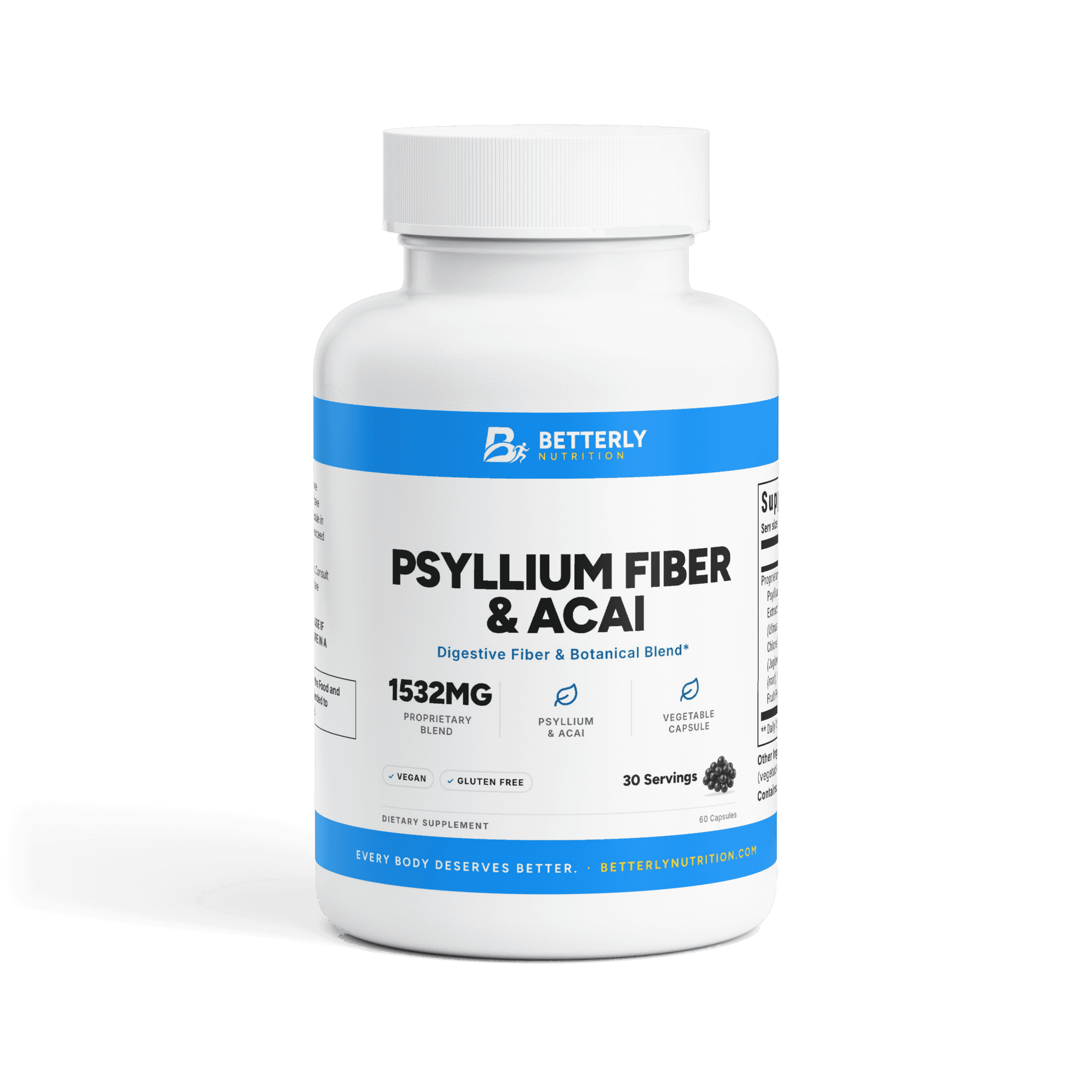
A fiber capsule can hold far more than fiber: our Psyllium Fiber & Acai Capsules name 11 ingredients inside one 1,532 mg proprietary blend per 2-capsule serving.
In the panel's own order: psyllium powder (husk), acai berry extract, inulin, slippery elm bark, aloe ferox powder (leaf) at 18% aloin, chlorella, black walnut hulls powder, ginger root, hyssop leaf, papaya fruit powder and lycopene 5%. The other ingredients are hypromellose (the vegetable capsule) and magnesium stearate. The label claims vegan and gluten free.
No ingredient in the blend gets its own amount. Blends are listed heaviest first, though, so each row's place in line caps its weight, a method our guide to reading a proprietary blend's ingredient order walks through. Here's that math for the four rows that bear on side effects.
| Ingredient on our panel | Position | Weight limit the order sets | Why it matters here |
|---|---|---|---|
| Psyllium powder (husk) | First of 11 | A floor near 139 mg | The fiber the name promises |
| Inulin | Third of 11 | A ceiling near 511 mg | A second fiber in the mix |
| Aloe ferox powder, 18% aloin | Fifth of 11 | A ceiling near 306 mg | Aloin is on FDA's stimulant laxative list |
| Black walnut hulls powder | Seventh of 11 | A ceiling near 219 mg | Declared tree nut allergen |
Run the aloe row to its ceiling and 18% of 306 mg comes to about 55 mg of aloin per 2-capsule serving. That's the most the listing order allows, not a measured amount, and the panel can't tell you how close to it the capsule sits. Psyllium's row cuts the other way: it's promised a floor near 139 mg, yet it could fill most of the 1,532 mg total.
One spelling note: the manufacturer's panel prints "Alion 18%," a misspelling we read as aloin.
The label's Contains line reads "Tree Nuts (Black Walnut Hull)," so if you avoid tree nuts, this capsule isn't for you.
From our shop: Psyllium Fiber & Acai Capsules — 60 vegetable capsules with psyllium husk listed first among 11 ingredients, including aloe ferox and black walnut hull, in a 1,532 mg blend per 2-capsule serving.
Is cape aloe a laxative?
Cape aloe (Aloe ferox) is best read as a laxative-type ingredient, because FDA's over-the-counter drug rules list aloe ingredients and aloin under the heading "stimulant laxatives."
That list is FDA's final order on non-monograph conditions (NM900). It lists active ingredients not generally recognized as safe and effective for certain over-the-counter drug uses. Under its laxative heading, aloe, aloe extract, aloe flower extract and aloin all sit in the stimulant group.
NCCIH's aloe page gives the backstory. In 2002, FDA required manufacturers to remove aloe latex from over-the-counter laxative products because of a lack of safety data.
Psyllium belongs to a different family. MedlinePlus calls it bulk-forming: it absorbs liquid, swells and adds bulk. Our capsule pairs the two in one shell. It's a dietary supplement that makes no laxative claim, and we name the category so you know what's in the bottle.
What side effects are linked to aloe ferox?
NCCIH lists abdominal pain, cramps and diarrhea for aloe latex taken by mouth, and those are the side effects to watch for with an aloin-rich aloe ferox powder.
Two honest caveats. NCCIH's page is written about aloe vera, not aloe ferox, and it splits aloe by leaf part: gel from the inner leaf, latex from the outer layer, and whole crushed leaf, which holds both. Our panel prints just "(leaf)", so we apply the latex cautions, the closest fit for a powder sold on its aloin content.
NCCIH on aloe taken by mouth:
- Oral aloe latex can cause abdominal pain, cramps and diarrhea.
- Overusing aloe latex may add to the adverse effects of cardiac glycosides, a class of prescription medicines.
- Aloe by mouth, as gel, latex or whole leaf extract, may be unsafe during pregnancy and while breastfeeding.
- Aloe leaf extracts taken by mouth, for as little as 3 weeks or as long as 5 years, have been linked to cases of liver harm.
- Animal studies raised further concerns about a non-decolorized aloe leaf extract, one not treated with activated carbon to remove its anthraquinone compounds.
Our panel doesn't say whether its aloe powder was decolorized. The label's own guardrail is its cap: "Do not exceed two capsules per day."
How much fiber do you actually get from a 2-capsule serving?
A 2-capsule serving of our Psyllium Fiber & Acai Capsules holds 1,532 mg of blend in total, so its psyllium is some unstated share of about 1.5 g.
MedlinePlus gives a recommendation of 21 to 38 grams a day for older children, teens and adults, and says Americans average about 16 grams. Even if our whole blend were fiber, and it isn't, one serving would barely dent that gap.
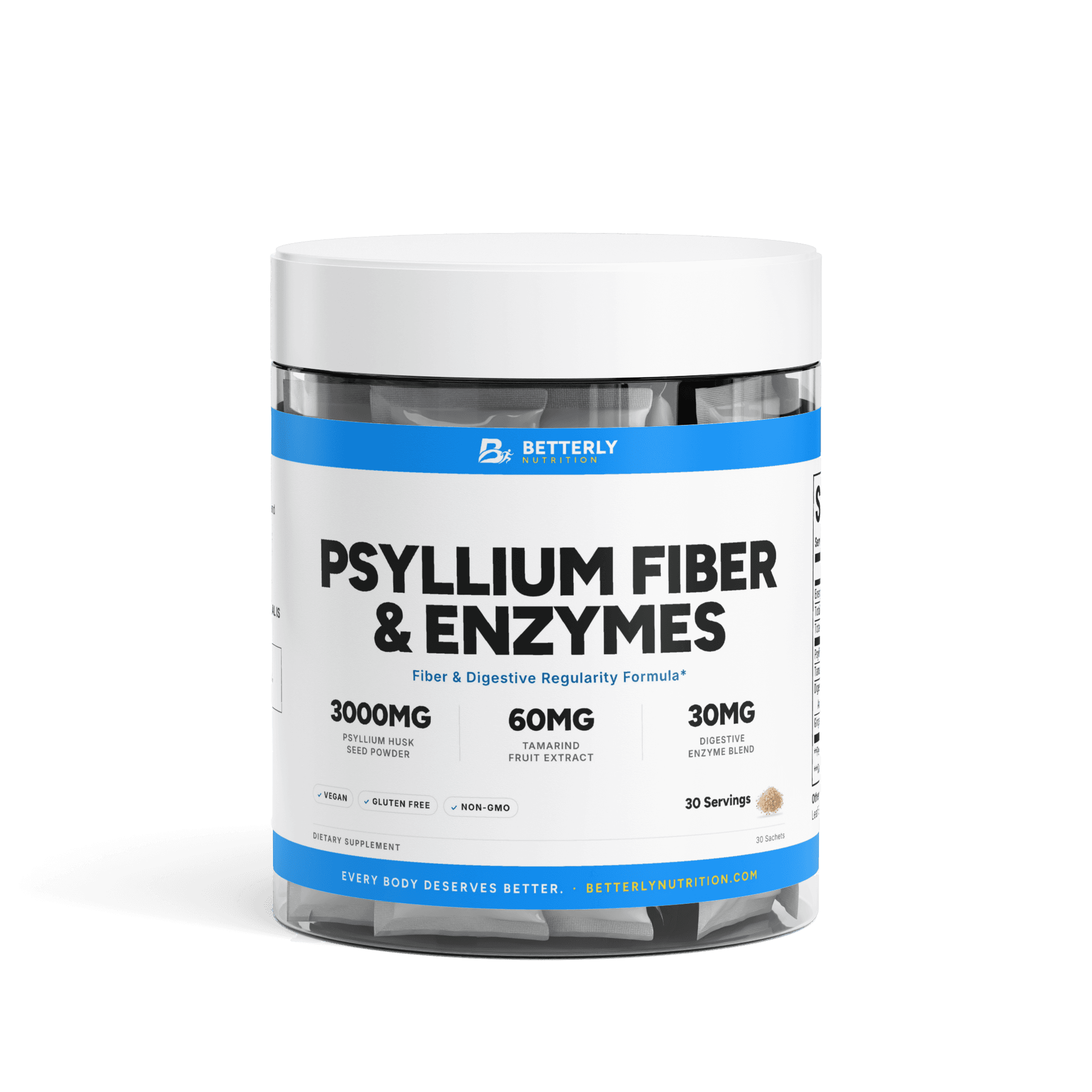
If you want psyllium with a printed number, we sell one other option: Psyllium Fiber & Digestive Enzyme Powder, a tub of 30 single-serve sachets. Here's how it compares with the capsule and a plain husk.
| Product and serving | Psyllium printed per serving | Other actives | Allergen line |
|---|---|---|---|
| Psyllium Fiber & Acai Capsules, 2 capsules | Not stated (inside 1,532 mg blend) | 10 more, incl. aloe ferox | Tree nuts (black walnut hull) |
| Psyllium Fiber & Digestive Enzyme Powder, 1 sachet | 3,000 mg psyllium husk seed powder | Tamarind, enzyme blend, ginger | None listed |
| Plain psyllium husk, any brand | Whatever its panel prints | None, if single-ingredient | Check its label |
If you want fiber and nothing else, pick a product that prints a psyllium number and carries no stimulant-type ingredient. Our capsule fails both tests, and it's better you hear that from us.
The sachet isn't plain psyllium either. Per 1-sachet serving it adds 15 mg of ginger root extract, 60 mg of tamarind fruit extract and a 30 mg digestive enzyme blend, with no aloe or walnut on its panel.
Its directions: stir 1 sachet into 6.8 fl oz (200 mL) of water, drink it straight away, and have 1 or 2 a day, away from meals. Since 200 mL falls about 40 mL short of MedlinePlus's 8-ounce (240 mL) psyllium minimum, drink more water after it to make up the difference.
The sachet label's caution says it isn't intended for children under 12, and it asks you to consult a physician before use or if you take medication, keeping the two at least 2 hours apart. MedlinePlus adds a powder-only caution: breathing in psyllium powder while mixing can cause allergic reactions.
From our shop: Psyllium Fiber & Digestive Enzyme Powder — a psyllium-first sachet that prints its amount, 3,000 mg per 1-sachet serving, with no aloe or tree nut on the panel.
How should you take Psyllium Fiber & Acai Capsules?
Take Psyllium Fiber & Acai Capsules as the label directs: 2 capsules a day, 1 during the day and 1 in the evening, never more than 2.
- Split the serving. One capsule by day and one in the evening means the bottle's 60 capsules last 30 days.
- Pour a full glass each time. The label sets no liquid amount, so use MedlinePlus's psyllium minimum of 8 ounces.
- Keep to the cap. The label says "Do not exceed two capsules per day," so a missed day never means four capsules the next.
- Don't stack aloe. Skip other products that list aloe, aloin or cascara, which share FDA's stimulant laxative group.
- Ask about medicines. Our capsule label gives no gap, and MedlinePlus keeps a few named medicines at least 3 hours away from psyllium, so let a pharmacist set yours.
If cramping or loose stools show up, those match the aloe latex effects NCCIH describes, so stop rather than push through.
When don't you need a fiber capsule at all?
You don't need our fiber capsule if fiber is the only thing you're after, if you avoid tree nuts, or if you'd rather not take an aloe ingredient every day.
Honest reasons to skip it:
- You want a known dose. A blend can't tell you how much psyllium you're getting, while a single-ingredient husk or our sachet can.
- Your plate already does the work. If beans, oats, fruit and vegetables fill your day, a capsule measured in milligrams adds very little.
- The water won't happen. Psyllium in any form needs a real glass of liquid each time.
- You already take something with aloe or cascara. Doubling up on stimulant-type ingredients is the wrong direction.
If digestion is your wider goal, the rest of our gut health and digestion range covers probiotics and enzymes, each with its amounts per serving listed.
Who should check with a healthcare provider first?
Talk to a healthcare provider before your first Psyllium Fiber & Acai capsule if you're expecting, breastfeeding, younger than 18, living with a health condition or on any medication.
The first four are on our label's caution. The rest come from the federal pages above:
- If you take any medicine, NCCIH advises talking with a provider before using aloe, and MedlinePlus wants your doctor and pharmacist to know every medicine, vitamin and herbal product you use before you start psyllium.
- If you've ever had difficulty swallowing, MedlinePlus asks you to tell your doctor before taking psyllium.
- If you plan on daily psyllium past a week, raise it. MedlinePlus, writing for over-the-counter drug use, says not to take psyllium longer than 1 week unless your doctor tells you to, while supplement labels like ours direct daily use.
- With a tree nut allergy, skip this capsule, since the label declares black walnut hull.
FAQ: fiber capsules side effects
Is aloe ferox the same as aloe vera?
No. Aloe ferox and aloe vera are separate aloe species, and aloe ferox is also called cape aloe or bitter aloe. On a label, the leaf part and the aloin figure tell you more than the species. NCCIH mentions food-grade aloe drinks containing no more than 10 parts per million of aloin. A powder standardized to 18% aloin, like the one in our capsule, is a very different ingredient.
Can you take cape aloe every day?
Our capsule's label does direct daily use, at no more than 2 capsules, but no federal page we read sets a safe long-term amount of cape aloe or aloin, so ask a provider before making it a habit. According to NCCIH, FDA had aloe latex removed from over-the-counter laxatives in 2002 over a lack of safety data. If everyday fiber is your goal, a psyllium product without aloe keeps that question off the table.
How long do fiber capsule side effects last?
Gas and bloating from fiber often ease as your gut's bacteria adapt to the added fiber, MedlinePlus says, though it gives no fixed timeline. Cramping or diarrhea that sticks around, trouble swallowing, or a rash are reasons to stop the capsule and talk to a doctor.
Can fiber supplements affect how you absorb minerals?
Yes, in large amounts. MedlinePlus says too much fiber may interfere with how your body absorbs minerals such as iron, zinc, magnesium and calcium. It adds that this usually isn't a big concern, because high-fiber foods tend to be rich in minerals. Our capsule's whole blend is 1,532 mg per serving, so its fiber load can only be small.
Are psyllium capsules safe?
Psyllium capsules can be, with two conditions: each dose goes down with plenty of liquid, and everything else in the formula suits you. MedlinePlus asks for at least 8 ounces (240 milliliters) of liquid with psyllium and wants your doctor told first if swallowing has ever been hard. A blend widens the question. Ours adds aloe ferox and black walnut hull, so the aloe cautions and a tree nut allergen come with the fiber.
Sources
- Aloe Vera: Usefulness and Safety, National Center for Complementary and Integrative Health
- Final Administrative Order OTC000007, Non-Monograph Conditions NM900, U.S. Food and Drug Administration
- Fiber, MedlinePlus Medical Encyclopedia
- Psyllium, MedlinePlus Drug Information
If this left you looking for somewhere to start, read psyllium and acai fiber capsules — its amounts per serving are listed on the page. For the practical questions this raises, how dosing, sourcing and subscriptions work is answered in one place.