On this page
- Key takeaways
- What are the most common mushroom powder side effects?
- Is it the mushrooms or the fiber blend?
- Why does inulin in a mushroom blend powder cause gas?
- What do the green tea and ginger in the fiber blend add?
- Do the mushrooms themselves have side effects?
- How should you take mushroom powder if your stomach is sensitive?
- Is there a mushroom supplement without added inulin?
- Is mushroom powder good for you, or can you skip it?
- Who should check with a healthcare provider first?
- FAQ: mushroom powder side effects
- Sources
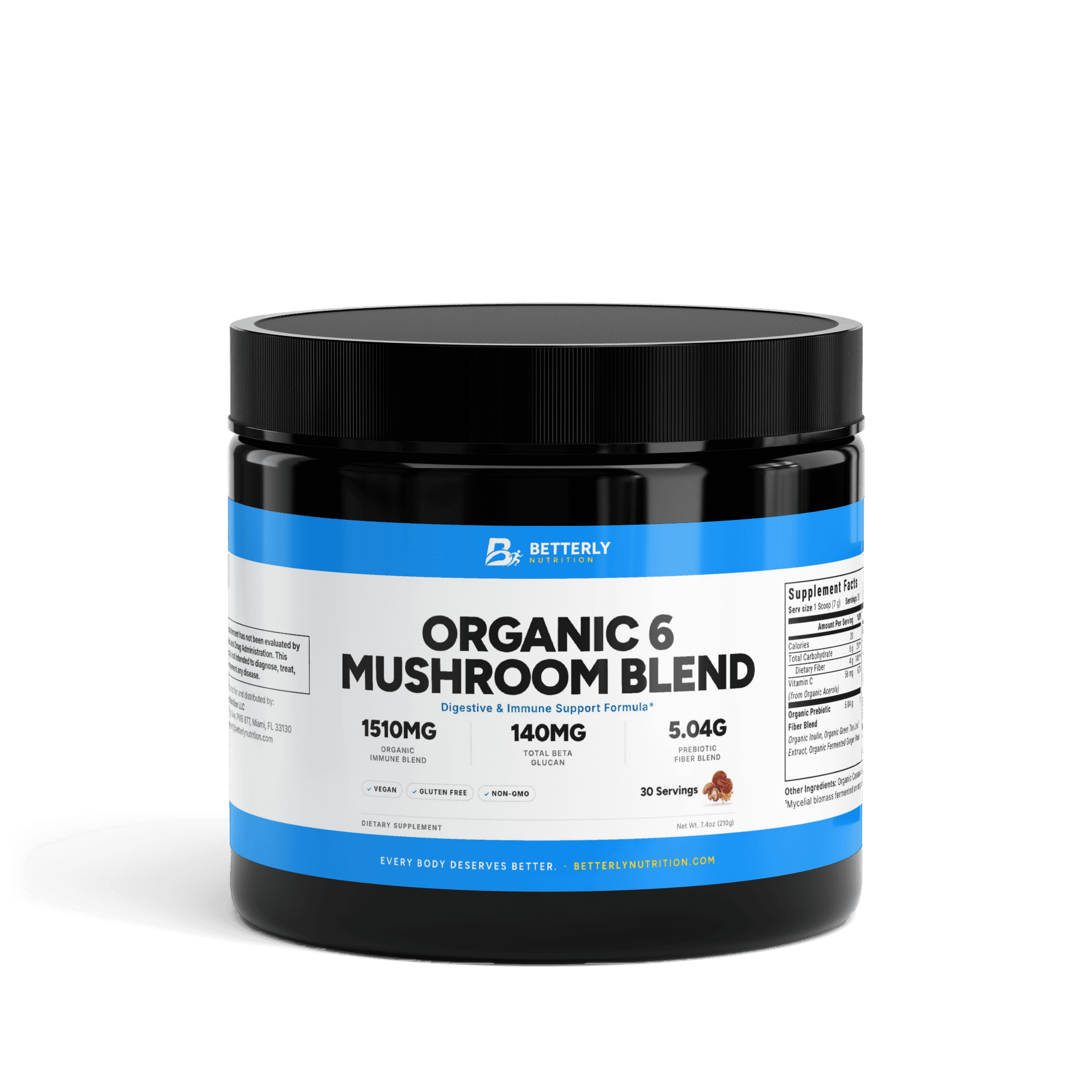
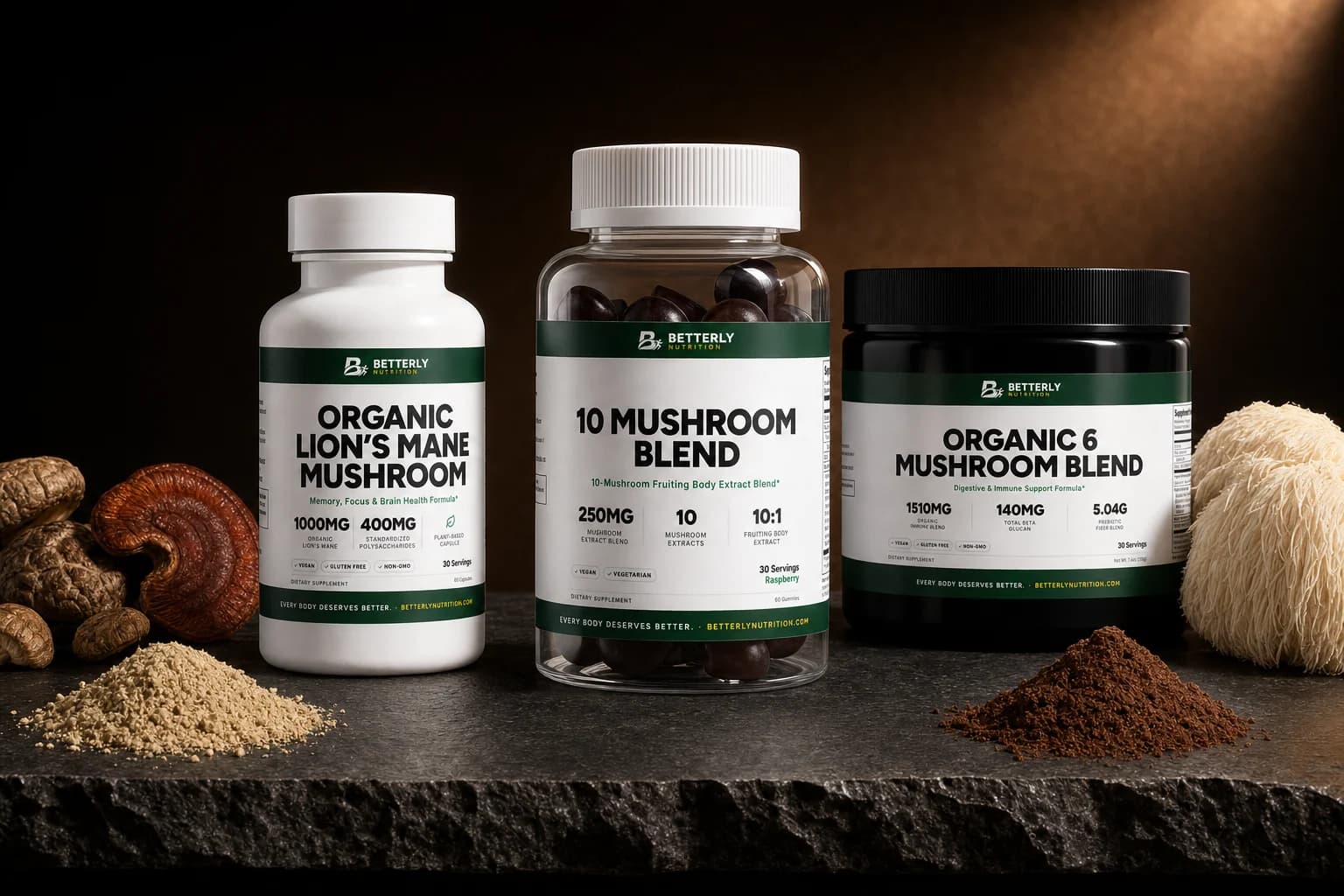
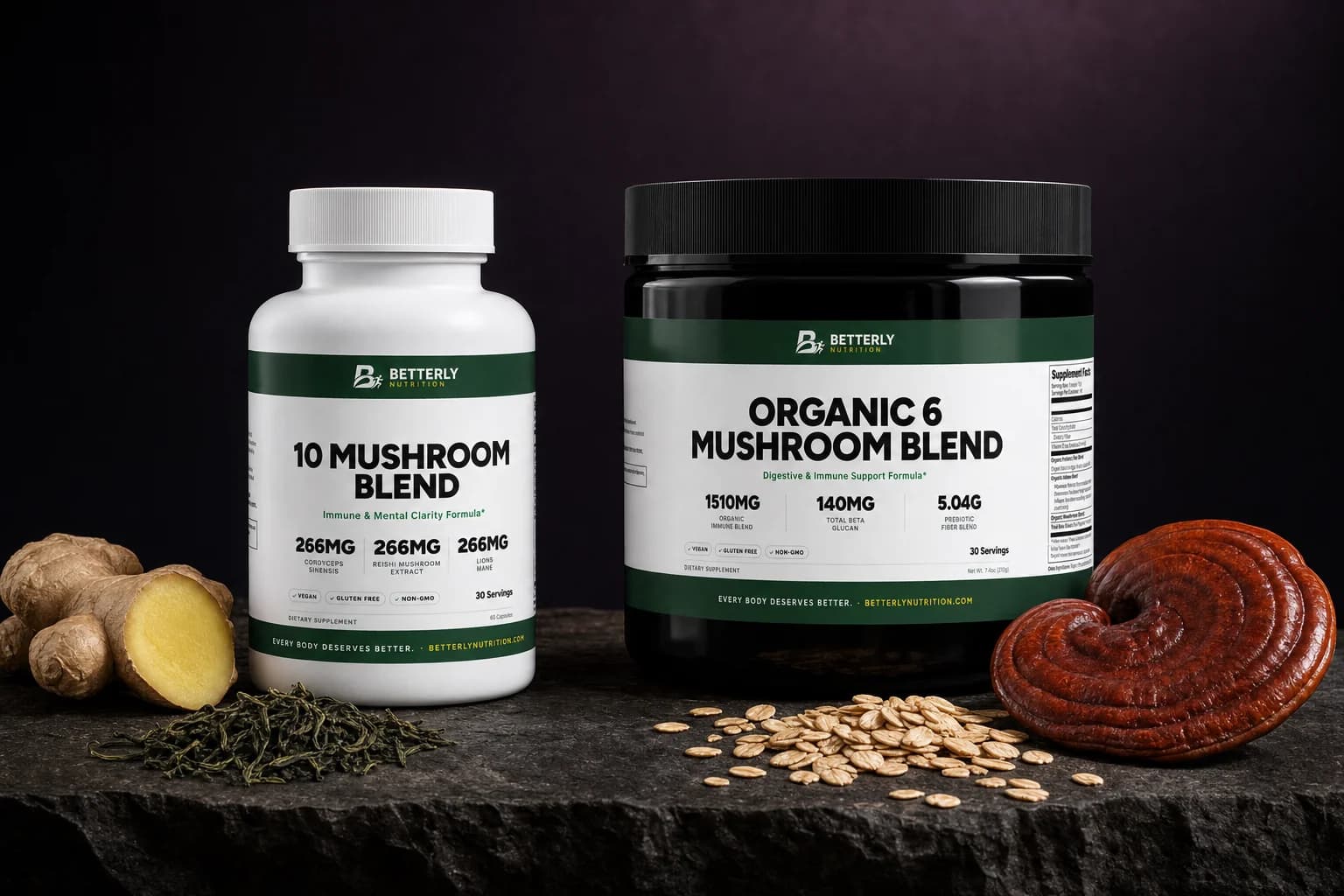
The short answer: Mushroom powder side effects tend to be digestive: gas, bloating, cramps or looser stools. In a blended powder, the added fiber is a likely cause, though some mushrooms carry short lists of their own. Our Organic 6 Mushroom Blend Powder pairs a 5.04 g prebiotic fiber blend, inulin listed first, with a 1,510 mg Organic Immune Blend of six mycelial mushrooms per 1-scoop (7 g) serving. Check both lines before you pick a suspect.
Key takeaways
- In our Organic 6 Mushroom Blend Powder, the fiber blend outweighs the six-mushroom mycelial blend by 3.53 g in every 7 g scoop.
- According to MedlinePlus, adding a lot of fiber at once can lead to gas, bloating and cramps.
- The fiber blend also holds green tea leaf extract and fermented ginger root, and federal pages list digestive side effects for both.
- NIH's LiverTox entry for cordyceps covers the Cordyceps militaris on our panel and lists mild effects, including nausea, diarrhea and rash.
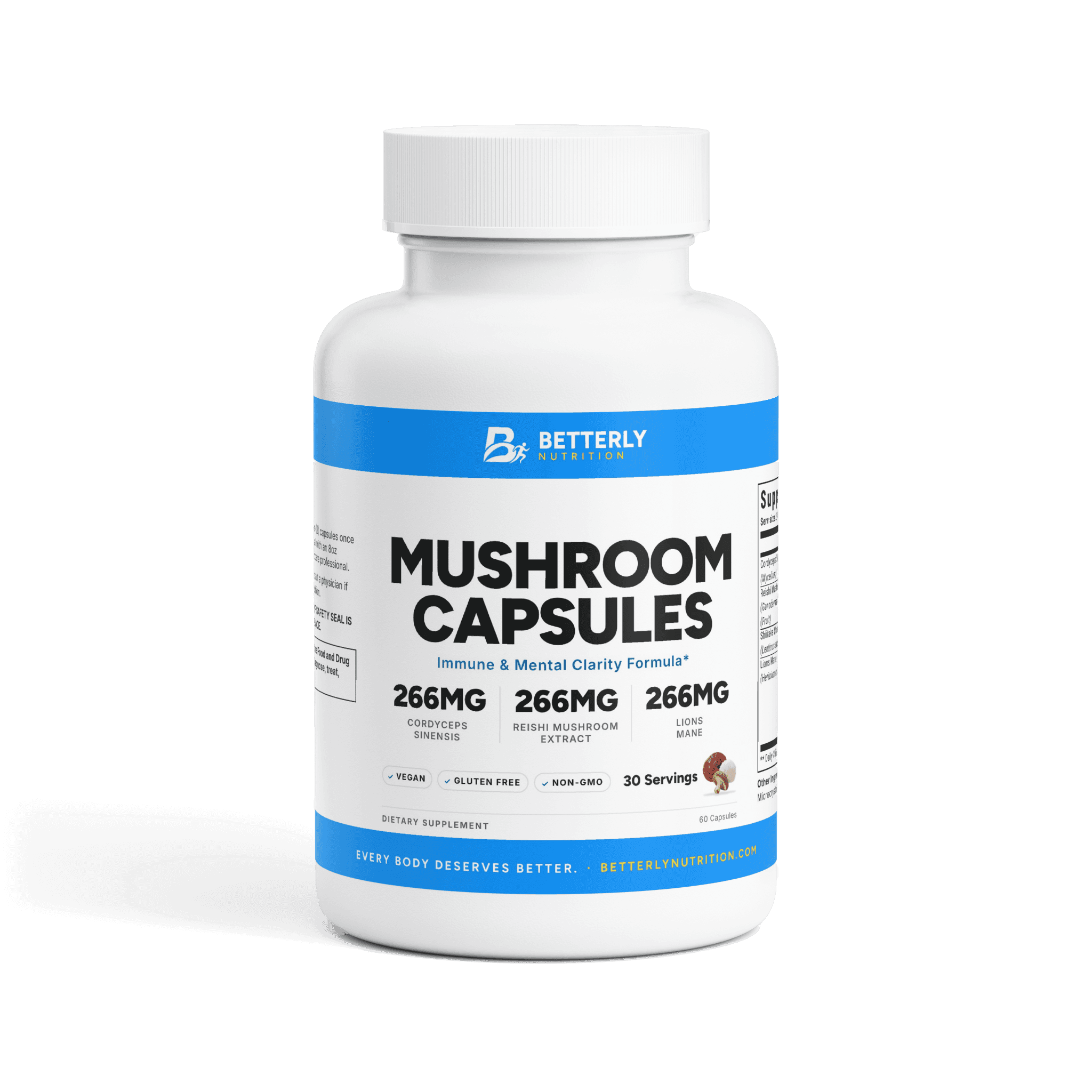
- Our Mushroom Capsules print no inulin and no fiber blend, which makes them the swap if inulin is the problem.
We sell the powder this guide takes apart and the capsules it offers as a swap, so we aren't neutral. Every product figure below comes off their printed panels, blank spots included.
What are the most common mushroom powder side effects?
In a blended mushroom powder like ours, the side effects you're likeliest to notice are digestive: gas, bloating, cramps or looser stools.
Our tub adds a fiber blend, two herbs, acerola and a starch carrier to its mushrooms, so we'll go one panel line at a time, starting with fiber, the heaviest. The MedlinePlus article on fiber links a sudden, large increase in fiber to gas, bloating and abdominal cramps.
The mushrooms aren't off the hook, either: a federal entry for cordyceps names some of the same stomach complaints.
Is it the mushrooms or the fiber blend?
In Organic 6 Mushroom Blend Powder, the 5.04 g fiber blend is a likely first suspect for stomach trouble, though cordyceps can cause some of the same symptoms.
That blend names organic inulin, organic green tea leaf extract and organic fermented ginger root, with only a combined weight. The mushrooms are mycelium, the thread-like growth a fungus makes before any cap appears, fermented on organic oats. Match what you notice to the lines that could be behind it:
| What you notice | Panel lines to suspect | A sensible first step |
|---|---|---|
| Gas, bloating or cramps | Inulin in the fiber blend | Take it with a meal and water |
| Looser stools | Fiber blend, ginger, cordyceps | Pause the scoop and see if it settles |
| Nausea | Green tea extract, cordyceps | Pause; retry only mixed into a meal |
| Stomach discomfort | Ginger, green tea extract, cordyceps | Pause the scoop and see if it settles |
| Constipation | Green tea extract | Keep water coming; stop if it lasts |
| Heartburn, mouth or throat irritation | Fermented ginger root | Stop and tell your provider |
| Rash, itching or swelling | Cordyceps, any mushroom, oats, any ingredient | Stop and get medical help |
The fiber blend or an herb inside it shows up in six of the seven rows, and cordyceps in four. So the table narrows the field without convicting one line. The rash row is the exception, and it never waits.
Why does inulin in a mushroom blend powder cause gas?
Inulin can cause gas because it's a fiber, and MedlinePlus links a quick, large rise in fiber to gas that often fades once the natural bacteria in your gut adjust.
What the label can't tell you is the inulin dose. The panel prints no figure for inulin within the 5.04 g blend or within the 4 g (14% DV) of dietary fiber. Our label math on how much of that fiber the mushrooms could supply comes at the gap from the other side.
What do the green tea and ginger in the fiber blend add?
The green tea leaf extract and fermented ginger root in Organic 6 Mushroom Blend Powder each carry their own side-effect lists, in amounts the label doesn't state.
The National Center for Complementary and Integrative Health (NCCIH) says on its ginger page that ginger taken by mouth can cause abdominal discomfort, heartburn, diarrhea, and mouth and throat irritation. That's where the heartburn row comes from.
For green tea, the NIH Office of Dietary Supplements (ODS) covers the extract in its fact sheet on supplements for immune function. The side effects it lists include nausea, constipation and stomach discomfort. The list has one more item, a cardiovascular one, so read the full entry with your provider, especially if a provider already keeps an eye on your heart and circulation. ODS also notes that tea contains caffeine, and our panel prints no caffeine amount.
Is mushroom powder bad for your liver? We found no federal page that says so about mushroom powders as a group. Green tea is the ingredient to flag. ODS warns that some green tea extracts might harm the liver, especially when taken on an empty stomach. How much extract sits in our blend is a blank on the panel, so we can't rule that in or out for a scoop. Since the label allows mixing it into food, a meal is the simple choice.
Do the mushrooms themselves have side effects?
Cordyceps, one of the six mushrooms in our powder, has a federal side-effect list: NIH's LiverTox names mild effects such as nausea, diarrhea and rash.
No federal page we found covers this six-species blend as a whole. LiverTox, NIH's liver-safety database for drugs, herbs and supplements, keeps single-species entries instead. Its cordyceps entry names Cordyceps militaris, the species on our panel, alongside Ophiocordyceps sinensis. It calls cordyceps extracts well tolerated and describes their side effects as minimal or mild: abdominal discomfort, diarrhea, dry mouth, nausea, poor appetite and rash. That entry describes extracts, while our panel lists mycelial biomass, so treat it as a close guide, not an exact match.
On the liver question, the same entry rates cordyceps an unlikely cause of liver injury. Reishi's record is different: a short list of rare case reports in NIH's LiverTox entry on reishi, two involving powdered reishi. Our reishi side-effects guide sets them out with their context. If your liver is being monitored, mention both mushrooms to your provider.
The panel lists a 1,510 mg Organic Immune Blend, made up of a Mushroom Mycelial Fermented Blend of:
- Cordyceps (Cordyceps militaris)
- Reishi (Ganoderma lucidum)
- Himematsutake, or royal sun agaricus (Agaricus blazei)
- Shiitake (Lentinula edodes)
- Maitake (Grifola frondosa)
- Turkey tail (Trametes versicolor)
No species gets its own amount. For who should skip cordyceps products altogether, see our cordyceps side-effects guide.
One rule holds for all six: if you've ever had an allergic reaction to eating mushrooms, leave the powder alone. Ask first if oats disagree with you, too, since the footnote says the mycelium was fermented on them.
What about mushroom extract side effects?
We found no federal source that compares side effects of mushroom extracts with mycelial powders, but the labels show what you'd be comparing.
In our Mushroom Capsules, eight of the ten species are fruiting-body extracts, lion's mane names the fruiting body without saying extract, and cordyceps is a mycelium powder. Every species in the powder is mycelial biomass.
That split can't tell you which form is gentler, and neither of our cordyceps rows is the extract LiverTox describes. What you can act on is the species list: if a mushroom has disagreed with you, look for its name on every row. Our side-by-side of extract and powder labels explains what "extract" on a row does and doesn't mean.
How should you take mushroom powder if your stomach is sensitive?
Organic 6 Mushroom Blend Powder is labeled for one scoop a day, mixed into food or drinks, and that's the ceiling.
The exact wording is "Take one (1) scoop daily mixed into food or drinks or as directed by a health professional." Its caution begins "Do not exceed recommended dose." Inside those limits, plan your first weeks as start, pause and stop:
- Start while everything else in your routine stays the same. If a new fiber product, a new herb and this scoop begin the same week, the table above can't point to anything. Stir the scoop into a meal, with water alongside, since MedlinePlus notes that water helps fiber move along.
- Pause if a mild digestive row shows up: gas that won't settle, looser stools, nausea or stomach discomfort. To restart at less than a full scoop, ask your provider; the label's "as directed by a health professional" leaves that call to them.
- Stop and call your provider if heartburn or throat irritation shows up, constipation lasts, a paused symptom comes back when you restart, or anything gets worse. A rash, itching or swelling means stopping and getting medical help right away.
From our shop: Organic 6 Mushroom Blend Powder — a 30-serving tub with every ingredient named on the panel, from the inulin and green tea to all six mushrooms, so you know what you're trying.
Is there a mushroom supplement without added inulin?
Yes. Our Mushroom Capsules list no inulin, no fiber blend and no Dietary Fiber row, so they're the swap if inulin is what bothers you.
Each 2-capsule serving lists five 266 mg rows: cordyceps, reishi, shiitake, lion's mane, and a proprietary blend of maitake, turkey tail, chaga, royal sun agaricus, white button mushroom and black fungus. The rest of each capsule is hypromellose (the vegetable shell), microcrystalline cellulose and magnesium stearate.
The swap has trade-offs:
- More species. Ten mushrooms instead of six means more chances to meet one you react to.
- No fiber. You give up the scoop's 4 g of dietary fiber.
- Different timing. Its directions call for two capsules once a day and, for best results, "20-30 min before a meal with an 8oz (237ml) glass of water." That's before food, not with it.
- The same caution, printed word for word.
Moving to the capsules means retiring the tub, since five species sit on both panels.
From our shop: Mushroom Capsules — five 266 mg rows covering 10 mushroom species per 2-capsule serving, with no inulin or fiber blend anywhere on the panel.
Is mushroom powder good for you, or can you skip it?
Organic 6 Mushroom Blend Powder's panel shows two measurable pluses per 1-scoop (7 g) serving: 4 g of dietary fiber and 56 mg of vitamin C (62% DV).
The vitamin C comes from acerola cherry. No federal page we read pins down what the six mushrooms add, and LiverTox's cordyceps entry says human trials haven't convincingly shown the effects promoted for it. You can skip the powder without missing much if:
- Inulin, ginger or green tea has given you trouble before. All three share the fiber blend.
- A cordyceps product has disagreed with you. This blend includes Cordyceps militaris.
- Your stomach is already unsettled and you don't know why. A fiber scoop would muddy the picture.
- You already take another mushroom blend. Doubling up gives each species more chances to disagree with you.
- You want to feel something happen. The label calls it a "Digestive & Immune Support Formula" and promises no sensation or time frame.
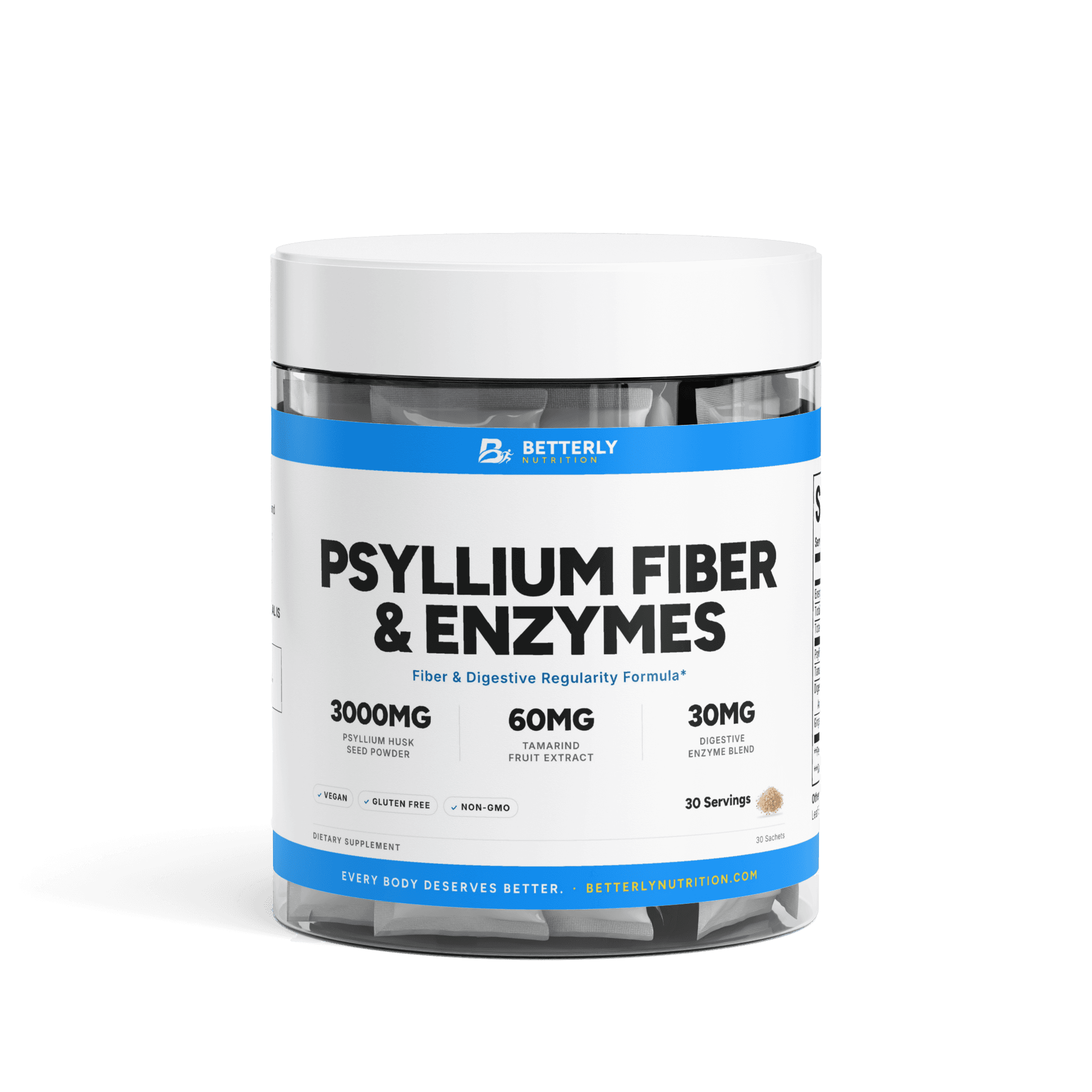
If you want fiber without mushrooms, our Gut Health & Digestion collection lays out the other formats.
Who should check with a healthcare provider first?
Talk to a healthcare provider before starting mushroom powder if you're pregnant, nursing, taking any medication, under 18, scheduled for surgery, managing a medical condition, or have reacted to mushrooms.
Both labels in this guide carry the same caution: "Do not exceed recommended dose. Consult a physician if pregnant, nursing, under 18, or have a medical condition." For the powder, we'd add:
- Pregnant or nursing. NCCIH says to ask your provider before using ginger in pregnancy. ODS puts safe caffeine in pregnancy at up to 200 mg a day, and our panel doesn't say what the green tea adds.
- Taking any medication. NCCIH's ginger page cautions that "some herbs and medicines interact in harmful ways," and ODS names possible tea interactions too. For the six mushrooms, we couldn't find a federal interaction list, so let your pharmacist check the panel.
- Surgery or dental work coming up. Put the tub on the list you hand your care team, and let them set the stop date.
- A provider watching your liver. Mention the green tea extract, the ODS empty-stomach caution and the LiverTox reishi case reports.
- A past reaction to mushrooms, oats, ginger or acerola. Skip the powder, and ask before trying the capsules, which hold more species.
Hand over the full Supplement Facts panel, not only the front label.
FAQ: mushroom powder side effects
Does mushroom powder make you poop more?
Mushroom powder can make you poop more, and in our blend the fiber is a likely reason: every 7 g scoop carries 4 g of dietary fiber. Ginger and cordyceps can also bring looser stools, according to NCCIH and LiverTox. If stools turn loose, pause the scoop. MedlinePlus says adding fiber slowly can help reduce gas or diarrhea, so ask your provider before restarting.
Does mushroom powder make you gassy?
Mushroom powder can make you gassy, and our blend's panel shows why that's possible: 4 g of dietary fiber per 7 g scoop, from a fiber blend that lists inulin first. MedlinePlus names intestinal gas among the effects of adding a lot of fiber quickly. The Mushroom Capsules print no fiber line. Gas that comes with pain, or doesn't ease, deserves a call to your provider.
Can mushroom powder make you sleepy or tired?
We found no federal source linking these six mushrooms to drowsiness, and our mushroom powder's panel lists no sleep ingredient such as melatonin. The green tea extract points the other way, since ODS notes tea contains caffeine. LiverTox lists fatigue among the symptoms in the rare reishi liver reports, though, so if it shows up after you start, stop and ask your provider.
How long do mushroom powder side effects last?
Our label sets no timeline for mushroom powder side effects, and none of our sources gives one. Fiber gas is the one effect MedlinePlus expects to fade as you adjust. For the rest, from ginger heartburn to the mild effects listed for cordyceps, the practical test is to stop the scoop and see what settles. Anything that worsens, or any rash, is a reason to call your provider.
Sources
- Fiber, MedlinePlus Medical Encyclopedia
- Ginger: Usefulness and Safety, National Center for Complementary and Integrative Health
- Dietary Supplements for Immune Function: Fact Sheet for Consumers, NIH Office of Dietary Supplements
- Cordyceps, LiverTox, National Library of Medicine, NIH
- Lingzhi, Reishi, LiverTox, National Library of Medicine, NIH
If this left you looking for somewhere to start, read mushroom powder with an inulin fiber blend — its amounts per serving are listed on the page. For the practical questions this raises, how dosing, sourcing and subscriptions work is answered in one place.